
FDU-PB-22 is a synthetic cannabinoid in the quinolinyl- and naphthyl-ester indole family. It contains a 4-fluorobenzyl group attached to the indole nitrogen and a naphthalen-1-yl ester at the 3-carboxyl position. The compound was detected in herbal blends in 2014. Research has clarified its metabolism and forensic markers, but controlled human pharmacology and toxicology data remain limited.
Chemistry and identification
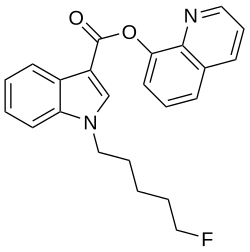
FDU-PB-22 is naphthalen-1-yl 1-(4-fluorobenzyl)-1H-indole-3-carboxylate. It is structurally related to FUB-PB-22, in which the naphthalene ester group is replaced by a quinolin-8-yl group. It is also related to PB-22 and 5F-PB-22, although those compounds have different N-substituents and ester structures.
FDU-PB-22 was detected in herbal blends in Japan, Russia and Germany in 2014. UNODC’s recommended forensic methods list it as a distinct quinolinyl/naphthyl ester synthetic cannabinoid and provide analytical identification data (UNODC recommended methods for synthetic cannabinoid analysis).
Pharmacology
FDU-PB-22 is classified as a synthetic cannabinoid receptor agonist, but detailed compound-specific receptor-binding and functional data are limited. Its structural relationship to PB-22 and other indole esters suggests cannabinoid receptor activity, but a reliable CB1 potency or efficacy value should not be inferred from structure alone.
Metabolism and forensic detection
A human metabolism study found that FDU-PB-22 was rapidly metabolised in human liver microsomes, with an estimated in-vitro half-life of 12.4 minutes. Seven metabolites were identified in hepatocyte incubations. The main pathways involved ester hydrolysis, followed by hydroxylation and glucuronidation. Two metabolites, a fluorobenzylindole carboxylic acid and its hydroxylated form, were also prominent in authentic urine specimens (Diao and colleagues, 2016).
The parent compound was not detected in the urine samples examined, illustrating why forensic laboratories often need to target metabolites rather than the unchanged drug. The same major hydrolysis products were observed for FUB-PB-22.
Reported effects and clinical evidence
Reliable human information on FDU-PB-22 is too limited to establish a characteristic experience. The metabolism study confirmed exposure in authentic urine samples, but was not designed to establish subjective effects or clinical toxicity. Reports involving PB-22 or other synthetic cannabinoids should not be attributed directly to FDU-PB-22.
Toxicity and research limitations
No well-characterised clinical case series has established the acute toxic range, dependence potential or long-term effects of FDU-PB-22. The available evidence is strongest for its chemical identity and metabolic pathways. The absence of human effect data leaves a gap in the evidence; it does not establish safety.
Related compounds
FDU-PB-22 is related to FUB-PB-22, 5F-PB-22 and PB-22. It differs from FUB-PB-22 by the naphthalene rather than quinoline ester group.
Reviews
There are no reviews yet.