
PB-22, also known as QUPIC, is a synthetic cannabinoid in the quinolinyl ester indole family. It was identified in herbal smoking products in 2012–2013 and became associated with acute neurological toxicity, including seizures. Laboratory studies show cannabinoid receptor activity, while human hepatocyte research has mapped its metabolism and identified urinary markers that help confirm exposure.
Chemistry and history
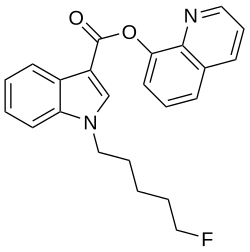
PB-22 is quinolin-8-yl 1-pentyl-1H-indole-3-carboxylate. It contains an indole core, a pentyl chain attached to the indole nitrogen and a quinolin-8-yl ester group. The ester linkage distinguishes it from many earlier naphthoylindoles, which contain a ketone between the indole and aromatic group.
PB-22 was reported in herbal smoking products and was later detected in clinical and forensic investigations. It is structurally related to 5F-PB-22, which carries a 5-fluoropentyl chain instead of the unfluorinated pentyl group.
Pharmacology
PB-22 is classified as a synthetic cannabinoid receptor agonist. Its quinolinyl ester structure is associated with cannabinoid receptor activity, although published potency values vary by assay and are not a direct measure of human effects. The compound’s clinical significance became clearer through toxicology reports rather than controlled human research.
Metabolism
Human hepatocyte experiments identified ester hydrolysis as the main metabolic pathway for PB-22. The study found 20 metabolites, most formed through oxidation with or without glucuronidation. Hydrolysis produces pentylindole-3-carboxylic acid metabolites, which were proposed as useful targets for urine testing (Wohlfarth and colleagues, 2014).
The parent compound may be difficult to detect after metabolism. Forensic methods therefore often target hydrolysis products and oxidised metabolites rather than relying only on unchanged PB-22.
Reported effects and clinical findings
A laboratory-confirmed case report described a 22-year-old man who experienced a generalised tonic-clonic seizure after exposure to a product called “Crazy Monkey”. He became severely agitated and required intubation. The product contained PB-22, while serum and urine also contained metabolites of UR-144. The patient recovered after hospital treatment, but later experienced another seizure after using the same product (Barceloux and colleagues, 2014).
The same investigation reported a seizure in the patient’s dog, which had also been exposed to the product. The report provides unusual but direct evidence of acute neurotoxicity associated with PB-22-containing material. The presence of UR-144 metabolites means that the contribution of each compound cannot be separated completely.
Toxicity and research limitations
PB-22 has been associated with seizures and severe agitation in confirmed exposure reports. However, the number of detailed clinical cases is small, and some exposures involve other synthetic cannabinoids. No controlled human study defines its acute toxic range, dependence potential or long-term effects.
Metabolism research has identified useful forensic markers, but has not fully established its pharmacokinetics in humans. Variability in herbal products and uncertain exposure amounts remain important limitations.
Related compounds
PB-22 is related to 5F-PB-22, FDU-PB-22 and FUB-PB-22. These compounds share an indole-3-carboxylate ester framework but differ in the N-substituent or ester-linked aromatic group.
Reviews
There are no reviews yet.