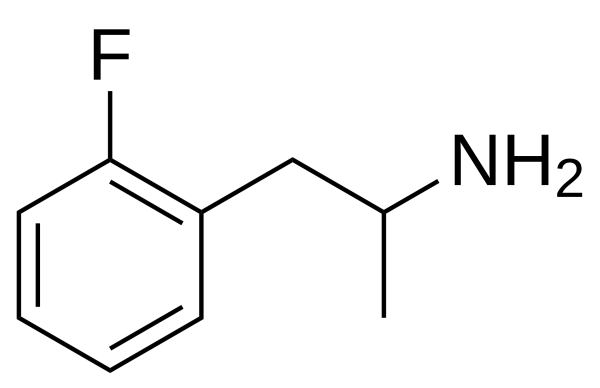
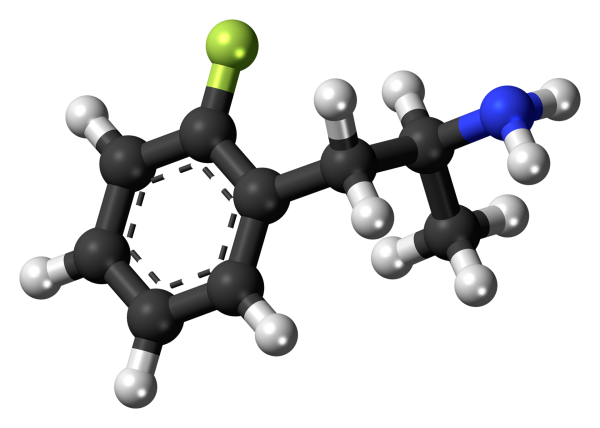
2-Fluoroamphetamine (2-FA) is a synthetic stimulant in the amphetamine family. It is a ring-substituted analogue of amphetamine, with a fluorine atom at the 2-position of the phenyl ring. It belongs to the same group of fluorinated amphetamines as 3-FA and 4-FA, but its effects are generally described as closer to those of conventional amphetamine than to entactogens such as MDMA.
Chemistry
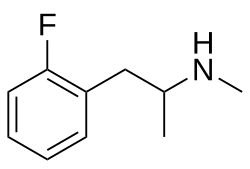
2-FA retains the basic amphetamine structure: a phenyl ring attached to an alpha-methylated ethylamine chain. The fluorine substituent sits next to the side chain, at the ortho position. This makes it a positional isomer of 3-FA and 4-FA, where the fluorine atom is attached at the meta and para positions respectively.
Unlike 2-FMA, 2-FA has no additional methyl group attached to the terminal nitrogen. It is therefore structurally closer to amphetamine than to methamphetamine. Small changes in the position of a ring substituent can alter a compound’s interaction with monoamine transporters, so the properties of the other fluoroamphetamine isomers cannot simply be assigned to 2-FA.
Pharmacology
The pharmacology of 2-FA has not been characterised as thoroughly as that of older amphetamines. It is generally thought to increase dopamine and norepinephrine signalling, probably through transporter-mediated release. Its serotonergic activity appears less prominent than that associated with 4-FA, although the available evidence is not sufficient to define a complete receptor and transporter profile.
A 2025 study compared several fluorinated amphetamine and methamphetamine analogues in mice and rats. 2-FA increased locomotor activity in mice and produced responses that substituted for methamphetamine in drug-discrimination tests. These findings show stimulant-like activity in animals; they do not establish its effects or relative potency in humans. The same study found that the different ring positions produced noticeably different behavioural profiles (Gatch and colleagues, 2025).
Subjective effects
Descriptions of the experience are drawn mainly from user reports collected in the PsychonautWiki 2-FA profile. The reports describe a relatively straightforward stimulant effect, although the intensity and balance of effects vary between accounts.
Physical effects
The physical effects are often described as fairly smooth and less forceful than those associated with some other amphetamines. Stimulation and increased stamina are common themes, while physical euphoria is usually described as present but not especially pronounced. Some reports also mention heightened tactile sensitivity.
Other reported effects include pupil dilation, reduced appetite, dehydration, sweating and an increased heart rate or blood pressure. Muscle tension, cramps, spasms, teeth grinding and stomach discomfort are also described. Less common reports include difficulty urinating, changes in bowel activity, temperature-regulation problems and seizures.
Cognitive effects
In accounts of milder experiences, the mental effects can be subtle. Users describe improved focus, motivation and analytical thinking, together with increased wakefulness and faster thoughts. Some also report mild cognitive euphoria, disinhibition or greater appreciation of music.
Some accounts also describe anxiety, paranoia, irritability and disorganised thinking, particularly after lost sleep. Compulsive redosing is also reported. A supposed ceiling to the stimulant effect is sometimes mentioned in user discussions, but this has not been demonstrated in controlled research.
After-effects
As the stimulation fades, users report cognitive fatigue, anxiety, low mood, irritability and reduced motivation. Some users describe depersonalisation or a lingering sense of wakefulness that makes it difficult to rest. These after-effects are not unique to 2-FA and are reported with other amphetamine-type stimulants.
Toxicity and research limitations
There is little clinical information on the acute or long-term toxicity of 2-FA. The 2025 animal study adds evidence of stimulant-like activity and possible abuse liability, but it cannot answer questions about repeated exposure, dependence or organ toxicity in people. Reports of serious effects associated with other fluorinated amphetamines should not be treated as direct evidence about 2-FA, although they illustrate why the safety of this group cannot be assumed.
Its metabolism and the contribution of individual transporters also remain poorly described. Descriptions of the subjective effects still rely largely on anecdotal accounts, with experimental research at an early stage.
Related compounds
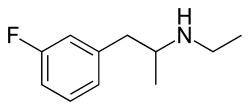
2-FA is commonly discussed alongside 2-FMA, 3-FA, 3-FEA and 4-FA. The first is its N-methyl analogue, while the others differ in either the position of the fluorine atom or the substitution on the nitrogen. These structural differences are reflected in the distinct effects reported for each compound.
Reviews
There are no reviews yet.