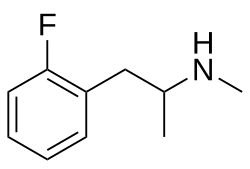
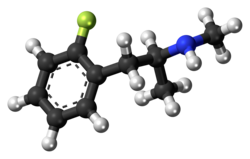
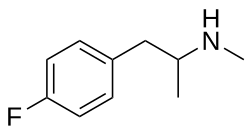
2-Fluoromethamphetamine (2-FMA) is a synthetic stimulant and a fluorinated analogue of methamphetamine. The fluorine atom is attached to the 2-position of the phenyl ring. It has been sold as a research chemical and is often described in user accounts as a long-lasting, relatively functional stimulant, although its pharmacology and long-term effects in humans remain incompletely understood.
Chemistry
2-FMA belongs to the substituted amphetamine family. Its structure is based on methamphetamine, with a fluorine substituent at the ortho position of the aromatic ring. It is also the N-methyl analogue of 2-FA. The position of the fluorine atom distinguishes it from 3-FMA and 4-FMA.
Pharmacology
Direct pharmacological research on 2-FMA has historically been limited. It has been proposed to act as a dopamine and norepinephrine releasing agent, in a manner broadly similar to methamphetamine. Its precise activity at the monoamine transporters and the contribution of other mechanisms have not been fully mapped.
A 2025 study compared 2-FMA with several fluorinated amphetamine and methamphetamine analogues in rodents. 2-FMA showed high potency in the locomotor assay, although its peak stimulant effect was lower than that of some of the other compounds. It also substituted for methamphetamine in drug-discrimination tests. The findings indicate stimulant-like activity, but they are animal data rather than a measure of human effects (Gatch and colleagues, 2025).
Research into its metabolism has identified N-hydroxylation and aliphatic hydroxylation as characteristic pathways. These findings distinguish its metabolic profile from that of methamphetamine, although the clinical significance of the metabolites is not yet clear (Ishii and colleagues, 2023).
Subjective effects
The following description reflects user reports collected in the PsychonautWiki 2-FMA profile. These reports often emphasise sustained stimulation and concentration, but they also describe a range of physical and psychological side effects.
Physical effects
Stimulation is usually described as pronounced and persistent. Some users characterise it as relatively clear-headed or “clean”, while others describe it as forced, with a sense of physical drive that can make it difficult to remain still. Physical euphoria is reported, but is generally considered less prominent than with some other stimulants.
Other reported effects include appetite suppression, dry mouth, dehydration, increased heart rate and blood pressure, sweating and pupil dilation. Teeth grinding, muscle tension, tremors and involuntary shaking are also described. Accounts of more intense effects also mention reduced fine motor control, dizziness and an abnormal heartbeat.
Cognitive effects
Users often describe improved focus, analysis, motivation and wakefulness. Thought acceleration and a more organised train of thought are also reported, alongside mild cognitive euphoria. Some accounts mention increased appreciation of music, libido and confidence.
Anxiety and paranoia are more likely to appear in reports involving prolonged wakefulness or repeated exposure. Some accounts also mention delusional thinking, disinhibition, ego inflation and compulsive redosing. These effects are not universal, and their frequency has not been established in clinical research.
After-effects
Reported after-effects include cognitive fatigue, anxiety, irritability, depression and reduced motivation. Some users describe headaches, depersonalisation, slower thinking or memory difficulties. Psychotic symptoms are also mentioned in reports involving intense or prolonged stimulant effects.
Toxicity and harm potential
The long-term safety of 2-FMA is not known. The animal findings from 2025 suggest that it has a substantial stimulant profile and may share some behavioural properties with methamphetamine. They do not establish a human risk level, but they make it difficult to regard the compound as pharmacologically mild.
The metabolic study adds information about how the body processes 2-FMA, but it does not establish whether its metabolites are toxic or how repeated exposure affects the liver and other organs. There is no well-defined clinical toxicity profile, and reports of effects associated with other fluorinated amphetamines should not be transferred directly to 2-FMA.
Related compounds
2-FMA is related to 2-FA, 3-FMA and 4-FMA. It is the N-methyl analogue of 2-FA and a positional isomer of the 3- and 4-fluoro compounds. The different substitution patterns produce measurable differences in animal studies.
Reviews
There are no reviews yet.