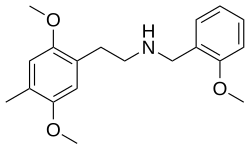
25D-NBOMe, also known as 2C-D-NBOMe, is a synthetic psychedelic in the N-benzylphenethylamine family. It is an N-(2-methoxybenzyl) derivative of 2C-D, with a methyl group at the 4-position of the phenyl ring. Laboratory studies show very high affinity and strong agonist activity at serotonin 5-HT2A and 5-HT2C receptors. Its human toxicology is less well documented than that of several other NBOMe compounds.
Chemistry
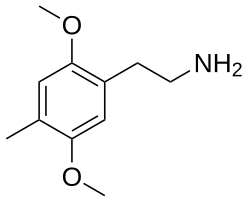
25D-NBOMe is based on the 2C-D phenethylamine structure, with methoxy groups at the 2- and 5-positions and a methyl substituent at the 4-position of the phenyl ring. The nitrogen carries a 2-methoxybenzyl group. This modification distinguishes it from 2C-D and places it in the NBOMe series.
Pharmacology
In a receptor study comparing several N-benzylphenethylamines, 25D-NBOMe showed subnanomolar binding affinity at the 5-HT2A receptor and high affinity at 5-HT2C. Functional assays found strong agonist activity at both receptors. Its activity at monoamine transporters was much weaker, supporting a predominantly psychedelic rather than conventional stimulant profile (Neurochemical pharmacology of substituted N-benzylphenethylamines, 2018).
Subjective effects
The PsychonautWiki profile of 25D-NBOMe describes psychedelic effects, though reliable human accounts are scarce. As with other NBOMe compounds, most descriptions are anecdotal.
Reports associated with the series include visual patterning, altered perception, stimulation and changes in thought and emotion. Anxiety, agitation and confusion are also described. These class-level observations should not be mistaken for a controlled, compound-specific effect profile for 25D-NBOMe.
Cardiovascular research
A 2019 study examined 25D-NBOMe and 25C-NBOMe in cell assays, rat electrocardiography and hERG potassium-channel testing. Both compounds reduced cell viability at the highest tested concentration and prolonged QT intervals in rats. 25D-NBOMe also inhibited hERG potassium channels, a finding relevant to cardiac repolarisation (Yoon and colleagues, 2019).
These findings indicate potential cardiotoxicity in experimental models. They do not establish the incidence of arrhythmias or other cardiac complications in people exposed to 25D-NBOMe.
Toxicity and research limitations
There is little compound-specific clinical literature on 25D-NBOMe. Severe poisoning and fatalities have been reported for other NBOMe analogues, but those cases are not direct evidence about 25D-NBOMe. Its own acute toxic range, metabolism, dependence potential and long-term effects remain insufficiently characterised.
The combination of very high serotonin-receptor activity and preclinical cardiac signals warrants caution when interpreting the compound’s safety. More human toxicology data would be needed to define its clinical risk profile.
Related compounds
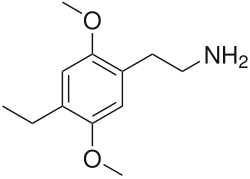
25D-NBOMe is related to 25B-NBOMe, 25C-NBOMe and 25E-NBOMe. These compounds share the N-(2-methoxybenzyl) substitution but differ in the group attached to the 4-position of the phenyl ring.
Reviews
There are no reviews yet.