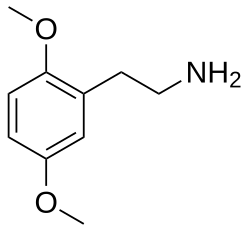
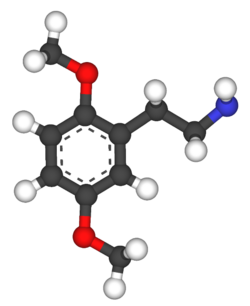
2C-H, or 2,5-dimethoxyphenethylamine, is the unsubstituted parent compound of the 2C family of psychedelic phenethylamines. Unlike better-known members such as 2C-B or 2C-I, it has no additional substituent at the 4-position of the phenyl ring. It is discussed mainly in chemical and structure–activity research; reliable information about recreational use and human effects is scarce.
Chemistry
2C-H contains a phenethylamine backbone with methoxy groups at the 2- and 5-positions of the aromatic ring. It is the structural parent for 2C compounds that carry a further substituent at the 4-position, such as bromine in 2C-B, chlorine in 2C-C, methyl in 2C-D and iodine in 2C-I.
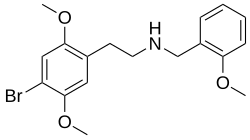
The term “2C” refers to the two-carbon chain between the aromatic ring and the amino group. 2C-H is also the parent structure for 25H-NBOMe, which carries an additional N-(2-methoxybenzyl) substituent.
Pharmacology
Receptor studies have included 2C-H in comparative panels of substituted phenethylamines and their NBOMe derivatives. The available data indicate interaction with serotonin receptors, but its functional activity is generally less well characterised than that of the more widely studied 2C compounds. The addition of an N-benzyl group can substantially change receptor affinity, as shown in studies comparing 2C compounds with their NBOMe analogues (Rickli and colleagues, 2015).
Subjective effects
Reliable human accounts of 2C-H are too limited to establish a characteristic experience. It is sometimes discussed as a psychedelic based on its structural relationship to the 2C family, but detailed descriptions of visual, cognitive or emotional effects are not supported by a substantial body of human observations.
Effects reported for 2C-B, 2C-C or other 4-substituted compounds should not be transferred directly to 2C-H. A small structural change can alter receptor activity, and the available evidence does not establish that the parent compound produces the same subjective profile.
Toxicity and research limitations
No detailed clinical series of 2C-H intoxications or human pharmacokinetic study specific to the compound was identified in the available literature. Its acute toxic range, metabolism, dependence potential and long-term effects remain uncertain.
Research on 25H-NBOMe is not a substitute for research on 2C-H. The NBOMe derivative has an additional N-benzyl group and a substantially different receptor-affinity profile.
Related compounds
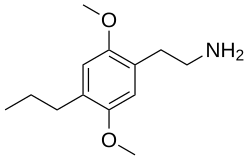
2C-H is related to 2C-B, 2C-C, 2C-D, 2C-E and 2C-I. Its N-benzyl derivative is 25H-NBOMe.
Reviews
There are no reviews yet.