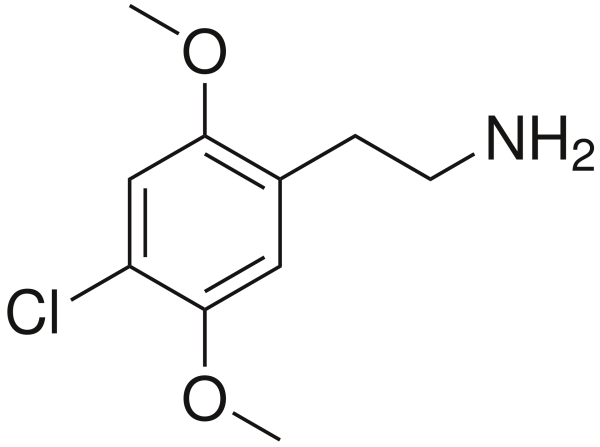
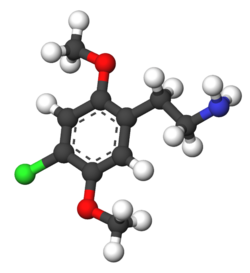
2C-C, or 4-chloro-2,5-dimethoxyphenethylamine, is a synthetic psychedelic in the 2C family. It has a chlorine atom at the 4-position of the phenyl ring and methoxy groups at the 2- and 5-positions. Laboratory studies show activity at serotonin 5-HT2A and 5-HT2C receptors, while human reports are comparatively sparse.
Chemistry and history
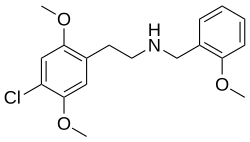
2C-C belongs to the series of 2,5-dimethoxy-substituted phenethylamines first explored in the late twentieth century. Its structure differs from 2C-B by the replacement of bromine with chlorine at the 4-position. The N-benzyl derivative of 2C-C is known as 25C-NBOMe, while the NBOH analogue is 25C-NBOH.
Pharmacology
In vitro studies have found that 2C-C acts as an agonist at 5-HT2A and 5-HT2C receptors. A comparative study of six substituted phenethylamines found that 2C-C produced hallucinogen-like responses in drug-discrimination tests in rats and showed agonist activity in receptor assays. It did not show a stimulant-like profile comparable to methamphetamine (Gatch and colleagues, 2013).
Other receptor studies have shown that adding an N-benzyl group can substantially increase 5-HT2A affinity. This is relevant to the distinction between 2C-C and 25C-NBOMe, which are chemically related but pharmacologically different compounds (Rickli and colleagues, 2019).
Subjective effects
The PsychonautWiki profile of 2C-C describes visual and cognitive changes during the psychedelic experience. These human accounts are largely anecdotal, with no substantial body of controlled clinical research to define its effects.
Visual and sensory effects
Reports describe colour enhancement, geometric patterning and changes in the apparent movement or shape of objects. Altered depth perception and closed-eye imagery are also mentioned. Accounts differ, so these changes cannot be expected to follow a predictable sequence.
Cognitive and emotional effects
Changes in thought, introspection and time perception are reported. Some users describe a calm or reflective experience, while others report anxiety, confusion or sensory overload. The evidence is not sufficient to estimate how frequently these effects occur.
Toxicity and research limitations
There are few analytically confirmed human intoxication reports specific to 2C-C. Case reports involving 25C-NBOMe should not be used as direct evidence about 2C-C, because the N-benzyl derivative has a substantially different receptor affinity and potency.
Animal and receptor studies support psychedelic activity, but do not establish a human toxic range or the long-term effects of repeated exposure. Its metabolism and dependence potential are also poorly documented.
Related compounds
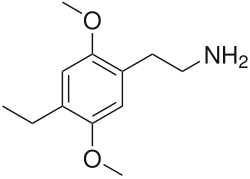
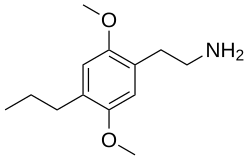
2C-C is related to 2C-B, 2C-D, 2C-E and 2C-I. Its N-benzyl derivatives include 25C-NBOMe and 25C-NBOH.

Reviews
There are no reviews yet.