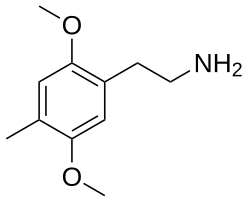
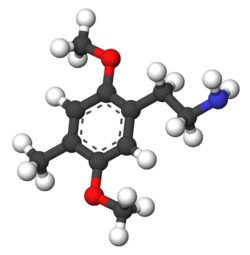
2C-D, or 4-methyl-2,5-dimethoxyphenethylamine, is a synthetic psychedelic in the 2C family of substituted phenethylamines. It carries a methyl group at the 4-position of the phenyl ring. Compared with several other 2C compounds, it is often described in user reports as relatively subtle, although laboratory studies confirm activity at serotonin receptors and hallucinogen-like effects in animal models.
Chemistry and history
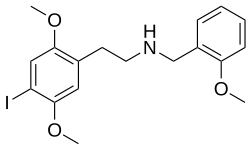
2C-D was synthesised and described by Alexander Shulgin as part of his work on substituted phenethylamines. Its structure contains methoxy groups at the 2- and 5-positions and a methyl group at the 4-position of the aromatic ring. It is the parent compound of 25D-NBOMe, which carries an additional N-(2-methoxybenzyl) group.
Pharmacology
2C-D interacts with serotonin receptors, particularly 5-HT2A and 5-HT2C. In a comparative study, it showed agonist activity at both receptors and produced hallucinogen-like responses in drug-discrimination tests in rats. At lower experimental exposures, it also increased locomotor activity, although the effect was not comparable to that of methamphetamine (Gatch and colleagues, 2013).
Its 4-methyl substitution is associated with lower receptor affinity than some halogenated 2C compounds in certain assays. This does not translate directly into a simple ranking of human psychedelic intensity.
Subjective effects
The PsychonautWiki profile of 2C-D includes users’ descriptions of an experience less forceful than with some other 2C compounds. They report changes in perception and thought, though the human evidence remains anecdotal.
Visual and cognitive effects
Reported effects include brighter colours, pattern recognition, altered depth perception and changes in the apparent movement of objects. Cognitive descriptions include introspection, altered associations, changes in time perception and a shift in emotional tone. Some accounts describe a relatively clear-headed experience, while others mention anxiety or confusion.
Physical effects
Reports include stimulation, nausea, muscle tension and changes in heart rate. The frequency and severity of these effects have not been established in clinical research.
Toxicity and research limitations
There is little compound-specific clinical toxicology for 2C-D. The laboratory evidence supports serotonergic psychedelic activity, but does not define its acute toxic range or long-term effects. Reports involving 25D-NBOMe should not be attributed to 2C-D, because the N-benzyl derivative has a markedly different receptor profile.
Human pharmacokinetic data and controlled studies of repeated exposure are lacking. The absence of a substantial case literature should be treated as a limitation of the evidence, not as proof of low risk.
Related compounds
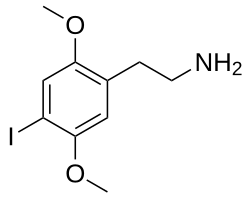
2C-D is related to 2C-B, 2C-C, 2C-E and 2C-I. Its N-benzyl derivative is 25D-NBOMe.
Reviews
There are no reviews yet.