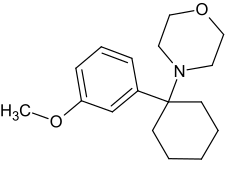
3-MeO-PCMo is a synthetic dissociative of the arylcyclohexylamine family. Its full chemical name is 4-[1-(3-methoxyphenyl)cyclohexyl]morpholine. It is a morpholine analogue of 3-MeO-PCP, in which the piperidine ring is replaced by a morpholine ring containing an oxygen atom. Research has confirmed activity at the NMDA receptor, although information about its effects in humans remains limited.
Chemistry
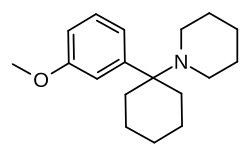
3-MeO-PCMo shares the 3-methoxyphenylcyclohexyl structure of 3-MeO-PCP. The difference lies in the nitrogen-containing ring: 3-MeO-PCP has a piperidine ring, while 3-MeO-PCMo has a morpholine ring with an oxygen atom in the ring. This change makes it a distinct analogue rather than a simple alternative name for 3-MeO-PCP.
Pharmacology
A 2017 study synthesised and characterised 3-MeO-PCMo and five related morpholine analogues. The compounds were screened against 46 central nervous system receptors, including the NMDA receptor. 3-MeO-PCMo showed moderate NMDA receptor affinity, broadly comparable to ketamine and approximately twelve times lower than PCP in the assay used. Among the tested morpholine analogues, the 3-methyl and 3-methoxy derivatives showed the strongest NMDA binding (Colestock and colleagues, 2018).
The results support the view that 3-MeO-PCMo can produce dissociative effects through NMDA receptor antagonism. Its activity at other targets and its effects in the human brain are not fully explained by these results.
Subjective effects
The PsychonautWiki profile of 3-MeO-PCMo lists a small number of user-reported effects, focusing on physical changes and dissociation rather than a broad range of visual phenomena.
Physical effects
Nausea and occasional vomiting are reported, particularly in more intense experiences. Loss of motor control can affect balance and coordination. Some users describe a feeling of bodily lightness or weightlessness, alongside physical euphoria and a sense of physical autonomy.
Cognitive effects
Reported cognitive effects include euphoria, disinhibition, conceptual thinking, introspection and changes in memory. Depersonalisation, derealisation, time distortion and thought deceleration are also mentioned. Some accounts describe mania or compulsive redosing, but the available reports are too limited to establish how often these effects occur.
Auditory and dissociative effects
Auditory suppression, distortions and hallucinations appear in the reported effect list. More broadly, users describe a separation from ordinary bodily and environmental awareness, consistent with the dissociative activity found in laboratory testing.
Toxicity and research limitations
The 2017 receptor study provides direct evidence of NMDA receptor binding, but there are few clinical data on 3-MeO-PCMo. Its metabolism, toxic range, dependence potential and long-term effects have not been adequately studied. User reports of nausea, motor impairment and memory disruption should therefore be treated as preliminary observations rather than a clinical profile.
Its relationship to 3-MeO-PCP does not mean that the two compounds have the same potency or risk profile. The change from a piperidine to a morpholine ring is chemically meaningful, and the measured receptor affinity differs.
Related compounds
3-MeO-PCMo is related to 3-MeO-PCP and to other arylcyclohexylmorpholines, including 2-MeO-PCMo, 4-MeO-PCMo and 3-Me-PCMo. These analogues differ in the position or type of substituent on the phenyl ring.

Reviews
There are no reviews yet.