
Methoxpropamine (MXPr) is a synthetic dissociative in the arylcyclohexylamine family and a close structural analogue of methoxetamine (MXE). It has the same methoxy-substituted phenylcyclohexanone core as MXE, but carries a propyl group rather than an ethyl group on the nitrogen. MXPr has been identified in illicit products and in a small number of toxicological reports, but its pharmacology and subjective effects remain poorly documented.
Chemistry and identification
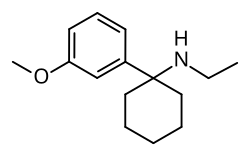
MXPr is 2-(3-methoxyphenyl)-2-(propylamino)cyclohexan-1-one. The propyl group distinguishes it from MXE, which has an N-ethyl substituent. It is also related to MXiPr, which carries an isopropyl group at the same position.
MXPr was identified in illegal products in Japan alongside MXiPr and DMXE in a 2022 analytical study. The researchers confirmed the compounds by instrumental analysis, documenting the emergence of several MXE-related derivatives in the illicit market (Tanaka and colleagues, 2022).
Pharmacology
Direct receptor studies of MXPr are limited. Its classification as a dissociative is based on its structural relationship to MXE and other arylcyclohexylamines that act as NMDA receptor antagonists. The available evidence does not establish a full receptor-binding profile or show whether the propyl substitution changes its activity in a predictable way.
A review of arylcyclohexylamine pharmacology lists N-depropylation, O-demethylation and reduction among the proposed metabolic pathways for MXPr. These findings are useful for forensic identification, but do not establish the clinical effects of the resulting metabolites (Arylcyclohexylamine derivatives review, 2022).
Subjective effects
There is no substantial, well-verified body of human experience data for MXPr. Some online descriptions compare it with MXE and other ketamine analogues, but the reports are too limited to define a typical experience. A detailed list of visual or cognitive effects would suggest a level of certainty that the evidence does not support.
Its chemical relationship to MXE makes dissociation and changes in body perception plausible, but these should be distinguished from effects directly observed in controlled studies. How pronounced stimulation, euphoria, sedation or hallucinations are in people remains unclear from the available literature.
Clinical reports and toxicity
A review of adverse events associated with new psychoactive substances describes one analytically confirmed non-fatal MXPr case. The person was reported to be asymptomatic on presentation to hospital. This single observation does not establish that MXPr is low-risk; it only shows that the reported case did not involve obvious acute symptoms (Reports of adverse events associated with NPS use, 2017–2020).
No reliable human toxic range, long-term safety profile or dependence assessment has been established. The available evidence is largely chemical identification, structural comparison and isolated toxicological observations.
Related compounds
MXPr is related to Methoxetamine, MXiPr, DMXE and O-PCE. The differences in their nitrogen substituents and aromatic groups are chemically significant, and their effects cannot be assumed to match.

Reviews
There are no reviews yet.