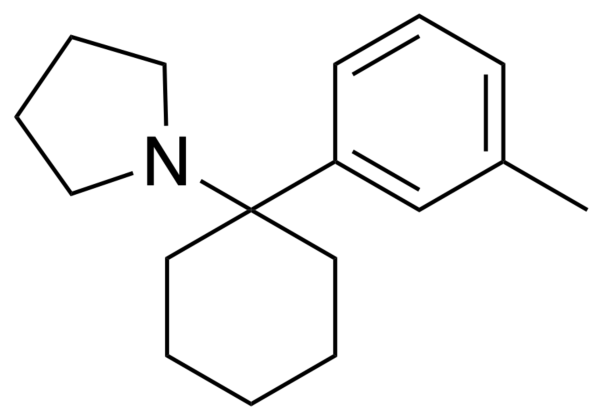
3-Methylrolicyclidine (3-Me-PCPy) is a synthetic dissociative in the arylcyclohexylamine family. It is a pyrrolidine analogue of phencyclidine (PCP), with a methyl group at the 3-position of the phenyl ring. The compound has been discussed on the research-chemical market, but its pharmacology and toxicity have not been characterised in formal human studies.
Chemistry
3-Me-PCPy contains a cyclohexyl group attached to a 3-methylphenyl ring and a pyrrolidine ring. The five-membered pyrrolidine ring distinguishes it from 3-Me-PCP, which contains a six-membered piperidine ring. It is also structurally different from methoxy-substituted compounds such as 3-MeO-PCP.
Pharmacology
3-Me-PCPy is described as an NMDA receptor antagonist, consistent with the dissociative properties of PCP-related arylcyclohexylamines. The available profile also suggests that it may affect dopamine, norepinephrine and serotonin transporters. However, the claim that it acts as a triple reuptake inhibitor is not supported by a published compound-specific transporter study and should be regarded as unverified.
The PsychonautWiki page for 3-Me-PCPy is a discussion page rather than a fully approved article. Its pharmacological and subjective descriptions include claims that still require independent confirmation.
Reported effects
User descriptions characterise 3-Me-PCPy as more stimulating and less immobilising than ketamine or methoxetamine. Some accounts describe the experience as having two broad phases: an initial euphoric rush, followed by more recognisable dissociation. This sequence comes from anecdotal accounts and may not be predictable.
Physical effects
Reports include stimulation, bodily euphoria and a sense of physical activation. Some users describe increased tactile sensitivity and improved bodily control, while stronger dissociation can lead to tactile suppression and motor impairment. Other reported effects include dizziness, restless legs, increased heart rate and blood pressure, sweating and dehydration.
Cognitive effects
Reported effects include euphoria, disinhibition, conceptual thinking and changes in creativity and memory. Mania, delusions and psychosis are also mentioned, particularly in accounts describing intense or compulsive use. The evidence is anecdotal, and the frequency of these reactions is unknown.
Visual and auditory effects
Some reports describe enhanced colour perception, visual acuity, tactile sensitivity and auditory perception at lower intensity. As the effects intensify, these may give way to visual and auditory suppression, double vision, reduced motor control and hallucinations. Internal imagery and altered perspective are also listed.
Toxicity and research limitations
There are no adequate clinical data on the acute toxicity, metabolism or long-term effects of 3-Me-PCPy. The proposed transporter activity has not been confirmed in a controlled assay, and there is no reliable basis for comparing its potency with other PCP analogues.
Reports of mania, delusions and psychosis are a concern, but they come from a limited and unverified body of user experience. The compound’s risk profile remains largely unknown.
Related compounds
3-Me-PCPy is related to PCP, 3-Me-PCP and other pyrrolidine-containing arylcyclohexylamines. The difference between pyrrolidine and piperidine analogues is structurally significant and may alter their pharmacological properties.

Reviews
There are no reviews yet.