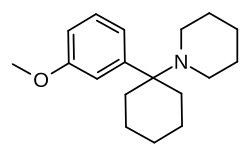
3-Methoxyphencyclidine (3-MeO-PCP) is a synthetic dissociative of the arylcyclohexylamine family and a methoxy-substituted analogue of phencyclidine (PCP). It is known for combining dissociation with a pronounced stimulating and euphoric character. Laboratory research has found high affinity at the NMDA receptor, while clinical reports describe severe intoxications, particularly in cases involving other substances.
History and chemistry
3-MeO-PCP was first synthesised in 1979 during research into PCP derivatives. It began to attract attention in online drug communities in the late 1990s and appeared on the research-chemical market in the following decade.
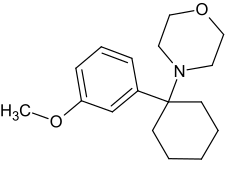
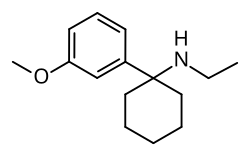
The molecule retains the piperidine and cyclohexyl framework of PCP, with a methoxy group attached to the 3-position of the phenyl ring. It is a positional isomer of 4-MeO-PCP and is closely related to 3-MeO-PCE, which has an ethylamine side chain instead of the piperidine ring.
Pharmacology
3-MeO-PCP is a potent NMDA receptor antagonist. In a receptor-screening study, it showed a binding affinity of 20 nM at the NMDA PCP site. The same study measured affinity at the serotonin transporter (216 nM) and sigma-1 receptor (42 nM). It did not show appreciable affinity for the dopamine transporter in the screening assay (Roth and colleagues, 2013).
The high NMDA affinity is consistent with its dissociative effects. Its activity at sigma-1 and serotonin targets may contribute to the broader profile, but the precise role of these interactions in human experience is not established.
Subjective effects
The PsychonautWiki profile of 3-MeO-PCP describes it as more stimulating and less physically immobilising than ketamine or methoxetamine. User reports, rather than controlled trials, are the main basis for the effects described below.
Physical effects
Stimulation can be prominent, with reports of bodily lightness, spontaneous physical sensations and physical euphoria. Accounts of milder effects describe heightened touch and colour perception, sharper vision and greater bodily control. As the dissociative effects become stronger, these enhancements may give way to tactile suppression, motor impairment and reduced sensory awareness.
Other reported effects include restless legs, reduced appetite, dizziness, increased heart rate and blood pressure, sweating and dehydration. Some accounts mention nausea, difficulty urinating and abnormal heartbeat.
Cognitive effects
Reports include cognitive euphoria, disinhibition, conceptual thinking, creativity and increased immersion. Changes in memory and time perception are also common themes. Some users describe a sense of unusual confidence or mental clarity, even when their behaviour is already impaired.
Mania, delusions and psychosis are among the most serious effects associated with 3-MeO-PCP in user reports. They may occur during the experience or as it fades. Compulsive redosing is another recurring concern, partly because the onset can feel subtle and users may underestimate the degree of intoxication.
Visual and auditory effects
During milder reported experiences, colours may appear stronger, vision sharper and patterns easier to recognise. Stronger effects include double vision, reduced frame rate, impaired visual acuity and difficulty recognising patterns. Auditory enhancement may also give way to sound suppression, distortion or hallucinations.
Dissociation
Disconnection from touch, vision and ordinary consciousness can develop as the experience intensifies. Some reports describe a sense of holes, spaces or voids in the environment, alongside a reduced connection to the body. Memory suppression and amnesia may accompany deeper dissociation.
Clinical intoxications
Several clinical reports document serious intoxication. In one Italian report, two young men were admitted in comatose states after using 3-MeO-PCP with alcohol. Both showed respiratory acidosis, hypothermia and neurological disturbance, and required intubation. The authors considered the symptoms consistent with combined exposure to 3-MeO-PCP and alcohol (3-MeO-PCP intoxication in two young men, 2017).
A later case report described repeated intoxication in a 17-year-old, with hypertension, tachycardia, confusion, abnormal muscle tone and agitation (Intoxication with 3-MeO-PCP alone, 2019). Other forensic reports have described fatal and non-fatal cases, often involving additional drugs. These cases demonstrate the potential for severe toxicity but do not establish a single toxic concentration or a risk level for every exposure.
Toxicity and dependence
The long-term health effects of 3-MeO-PCP have not been established in controlled studies. User reports describe rapid tolerance, psychological dependence and withdrawal symptoms after repeated use. Mania, psychosis and severe confusion are prominent concerns, particularly in accounts involving prolonged or compulsive use.
Clinical cases show that intoxication can involve profound impairment of consciousness, agitation, cardiovascular changes and respiratory complications. The contribution of alcohol or other co-ingestants is important when interpreting these reports.
Related compounds
3-MeO-PCP is related to PCP, 4-MeO-PCP, 3-MeO-PCE and 3-HO-PCP. It is one of the more extensively studied novel PCP analogues, although its human safety profile remains incomplete.

Reviews
There are no reviews yet.