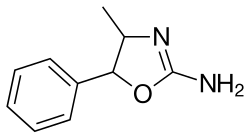
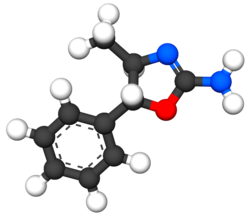
4-Methylaminorex (4-MAR), also known by the street names U4Euh, Ice and 4-MAX, is a synthetic stimulant in the aminorex family. It is a methylated derivative of aminorex, an amphetamine-like compound originally developed as an appetite suppressant. 4-MAR appeared as a recreational drug in the late 1980s and has been associated with severe cardiovascular complications, including reports of pulmonary hypertension.
History and chemistry
4-MAR was first synthesised during research into aminorex derivatives in the early 1960s. It was patented by McNeil Laboratories in 1966, but was not developed into a widely used pharmaceutical medicine. The compound emerged on the recreational market roughly two decades later, particularly in the United States, where it was sold under names such as U4Euh and Ice. Its history and the reported pulmonary complications of aminorex analogues are reviewed in Aminorex analogs: a review.
Unlike cathinones, 4-MAR does not contain a β-keto group. It belongs to the 2-amino-5-aryloxazoline group, with a five-membered oxazoline ring and a methyl substituent. It is also chiral and can occur as cis and trans diastereomeric forms.
Pharmacology
4-MAR is a monoamine stimulant. In vitro studies found that it preferentially inhibits the norepinephrine and dopamine transporters and can also act as a substrate releaser at the dopamine transporter. Its profile was more similar to amphetamine than to MDMA, with comparatively weaker serotonergic activity (Rickli and colleagues, 2019).
Earlier animal work found stimulant and appetite-suppressing effects. The compound’s long-lasting stimulant action was one of the features described in reports from the recreational market, although there are few controlled human studies that define its duration or clinical effects.
Subjective effects
The available descriptions of 4-MAR come mainly from historical reports and user accounts. The PsychonautWiki discussion of 4-methylaminorex is not a fully developed substance article, so its effect descriptions should be treated as anecdotal rather than as a settled profile.
Reports describe a strong, long-lasting stimulant effect, with increased energy, wakefulness and confidence. Other accounts mention euphoria and reduced appetite. The limited human literature does not support a reliable breakdown of cognitive, emotional or sensory effects.
Cardiovascular toxicity
Cardiovascular harm is the main serious concern associated with 4-MAR. Aminorex, the parent compound, was withdrawn from medical use in Europe after cases of pulmonary arterial hypertension were reported. Pulmonary hypertension has also been associated with recreational use of 4-MAR (Review of aminorex analogues, 2018).
A fatality associated with 4-MAR was reported in the late 1980s, with the autopsy findings suggesting cardiac and pulmonary failure, including pulmonary and cerebral oedema. The case literature is small, but the combination of stimulant pharmacology and reported pulmonary vascular complications makes the compound a significant toxicological concern.
Research limitations and related compounds
There are few controlled human studies of 4-MAR, and its long-term effects are not fully characterised. The 2019 transporter study clarifies its monoamine activity, but does not establish a complete clinical risk profile or explain the mechanisms behind pulmonary hypertension.
4-MAR is related to Aminorex, 4,4′-DMAR and 3,4-DMAR. These compounds share the aminorex framework but differ in their ring substitutions and pharmacological profiles. 4,4′-DMAR has been associated with a separate cluster of deaths; those findings cannot be attributed to 4-MAR.

Reviews
There are no reviews yet.