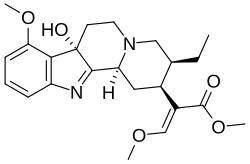
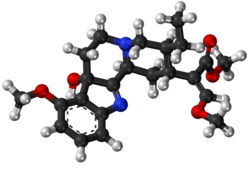
7-Hydroxymitragynine (7-OH) is an opioid alkaloid found naturally in trace amounts in the leaves of the kratom tree, Mitragyna speciosa. It is also formed in the body from mitragynine, the main alkaloid in kratom. Unlike most kratom alkaloids, 7-OH has strong activity at the μ-opioid receptor and can produce opioid-like effects, including analgesia, sedation and respiratory depression. Concentrated products containing 7-OH have become a public-health concern.
Natural occurrence and products
7-OH is a minor constituent of natural kratom leaf, representing less than 2% of the total alkaloid content in the material described by the US Food and Drug Administration. It is also produced through oxidation of mitragynine in the body. Commercial products marketed as high-strength 7-OH may contain much greater concentrations than are present in ordinary kratom leaf.
The FDA has distinguished concentrated 7-OH products from traditional kratom leaf products in its public-health assessment. It noted that the enhanced concentrations found in some commercial products are likely to result from processing mitragynine-rich extracts rather than direct extraction of the trace amounts present in the plant (FDA scientific assessment, 2025).
Pharmacology
7-OH acts primarily as a μ-opioid receptor agonist. In vitro studies have found high affinity for this receptor, and animal studies demonstrate opioid-like analgesic and rewarding effects. Its activity is stronger than that of mitragynine in several experimental models.
Animal research has also shown respiratory depression, physical dependence and withdrawal after repeated exposure. These findings resemble the effects of established opioids, although potency comparisons in animals cannot be used directly to estimate human doses or risks.
Effects and adverse reactions
Clinical experience and toxicological reports associate 7-OH with opioid-like intoxication. Reported effects include analgesia, sedation and reduced alertness. More serious effects include respiratory depression, loss of consciousness and overdose. Dependence and withdrawal have also been reported, particularly in connection with concentrated products.
The American College of Medical Toxicology stated in August 2026 that concentrated 7-OH products have been linked to overdose and death, and that clinical experience includes respiratory depression, dependence and withdrawal (ACMT position statement, 2026).
Toxicity and dependence
The main acute danger is opioid-related respiratory depression. The risk is especially concerning when concentrated 7-OH products are combined with other central nervous system depressants. Repeated exposure can lead to physical dependence, and withdrawal may involve symptoms characteristic of opioid withdrawal.
The FDA’s review concluded that the available preclinical evidence supports a substantial abuse liability and highlighted the rapid growth of concentrated 7-OH products. The agency also noted that more clinical research is needed to define the human safety profile and the effects of long-term exposure.
Research limitations
Although receptor and animal studies provide a clear indication of opioid activity, controlled human studies remain limited. The composition of retail products can vary, and findings from purified 7-OH cannot automatically be applied to all kratom products. Traditional kratom leaf, mitragynine-rich extracts and concentrated 7-OH products should be distinguished when interpreting clinical reports.
Related compounds
7-OH is related to Mitragynine and other alkaloids found in Mitragyna speciosa. It is not a synthetic cathinone; its pharmacology is opioid-like and its chemical origin is distinct from the stimulant compounds in that group.

Reviews
There are no reviews yet.