
S-Ketamine, also known as esketamine or (S)-ketamine, is one of the two enantiomers of ketamine. It is the more potent of the two forms at the NMDA receptor and is used medically as a dissociative anaesthetic. A nasal-spray formulation of esketamine is also approved for certain adults with treatment-resistant depression and depressive symptoms associated with acute suicidal ideation or behaviour, under medical supervision.
Chemistry and stereochemistry
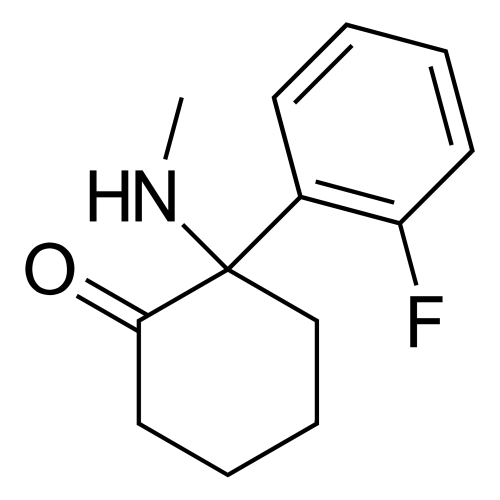
Ketamine has a chiral centre and exists as two mirror-image molecules: S-(+)-ketamine and R-(−)-ketamine. Racemic ketamine contains equal amounts of both enantiomers. S-ketamine is the active ingredient in esketamine medicines, including the nasal spray marketed as Spravato.
The two enantiomers have the same molecular formula and connectivity, but differ in their three-dimensional arrangement. This difference affects receptor affinity and some pharmacological properties.
Pharmacology
Esketamine is a non-competitive NMDA receptor antagonist. It has greater affinity for the NMDA receptor than R-ketamine, with reviews commonly describing an approximately four- to five-fold difference in binding affinity. Its effects also involve downstream changes in glutamate signalling and synaptic plasticity, although the mechanisms underlying its antidepressant action are not fully resolved.
Ketamine and its enantiomers have been investigated at several additional targets, but NMDA receptor antagonism remains central to the established pharmacological description. Differences in receptor affinity do not by themselves explain every difference in clinical response (The antidepressant actions of ketamine and its enantiomers, 2023).
Medical use
Esketamine is used as an anaesthetic and analgesic in clinical settings. Its intranasal formulation is approved in the United States for adults with treatment-resistant depression, either alone or together with an oral antidepressant. It is also indicated, in conjunction with an oral antidepressant, for depressive symptoms in adults with major depressive disorder and acute suicidal ideation or behaviour.
The official prescribing information states that the effectiveness of esketamine in preventing suicide or reducing suicidal ideation or behaviour has not been demonstrated. Improvement after treatment does not remove the need for hospitalisation when clinically indicated. Treatment is administered under a restricted programme with monitoring because of sedation, dissociation, respiratory depression and misuse risks (DailyMed: Spravato prescribing information, 2026).
Subjective and dissociative effects
The PsychonautWiki ketamine profile describes the dissociative effects associated with ketamine, including analgesia, changes in body perception, memory suppression and depersonalisation. Most recreational reports do not identify the enantiomer used, so they cannot always be attributed specifically to S-ketamine.
Physical effects
Ketamine’s physical effects can include analgesia, sedation, impaired motor coordination and reduced tactile awareness. Some people experience dizziness, nausea, changes in heart rate or blood pressure and temporary difficulty moving normally. In medical settings, these effects are monitored because the intensity can vary between individuals.
Cognitive and perceptual effects
Dissociation may involve a feeling of separation from the body or surroundings, changes in time perception and memory disruption. More intense effects can substantially impair awareness and the ability to communicate. These effects are part of ketamine’s anaesthetic profile, but can also occur as adverse effects outside controlled medical use.
Safety and adverse effects
Esketamine can cause dissociation, sedation, dizziness, nausea, increased blood pressure and impaired attention. The prescribing information includes warnings about respiratory depression, abuse and misuse. Patients are monitored after administration and are not expected to drive or operate machinery until the effects have resolved according to the product’s clinical requirements.
Repeated non-medical ketamine exposure has been associated with urinary tract and bladder problems, cognitive difficulties and psychological dependence. It is not yet clear how much these risks differ between S-ketamine and racemic ketamine.
Related compounds
S-ketamine is the enantiomeric counterpart of R-Ketamine (arketamine). The two forms have the same molecular formula but different spatial arrangements and receptor affinities. Racemic ketamine contains both.

Reviews
There are no reviews yet.