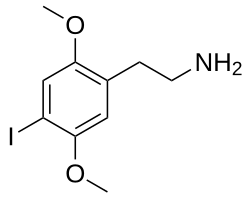
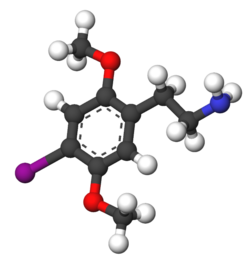
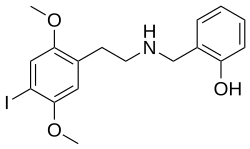
2C-I, or 4-iodo-2,5-dimethoxyphenethylamine, is a synthetic psychedelic in the 2C family. It has an iodine atom at the 4-position of the phenyl ring and methoxy groups at the 2- and 5-positions. 2C-I acts on serotonin receptors and has been associated with acute intoxications involving seizures, serotonin syndrome, agitation and hallucinations. It is the parent compound of 25I-NBOMe and 25I-NBOH.
Chemistry and history
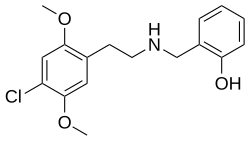
2C-I was developed as part of research into substituted phenethylamines and became known in recreational markets in the early 2000s. Its structure is similar to 2C-B and 2C-C, with iodine replacing bromine or chlorine at the 4-position. The N-benzyl derivative 25I-NBOMe has a much higher affinity for 5-HT2A receptors than the parent compound.
Pharmacology
2C-I acts primarily through serotonin receptors, particularly 5-HT2A. In receptor assays it showed agonist activity in one signalling pathway and a different, antagonist-like response in another, illustrating that its functional profile depends on the experimental model. It also showed low-potency interaction with the serotonin transporter in comparative studies (Gatch and colleagues, 2013).
A 2026 CFSRE monograph describes 2C-I as a selective serotonergic hallucinogen and notes that it had been identified in a drug-material sample, although the laboratory had not identified it in toxicology specimens by January 2026 (CFSRE 2C-I monograph, 2026).
Subjective effects
The PsychonautWiki profile of 2C-I describes visual changes, stimulation and altered cognition during the psychedelic experience. Human accounts vary, and clinical case reports show that severe adverse reactions can occur.
Visual and cognitive effects
Reports include geometric visuals, intensified colours, changes in depth perception and altered movement. Cognitive effects may include introspection, changes in time perception and unusual thought associations. Anxiety, agitation and confusion are also reported.
Clinical toxicity
A case report described a 19-year-old man who developed recurrent generalised seizures and serotonin syndrome after exposure to 2C-I. He experienced hyperadrenergic symptoms and prolonged respiratory failure, but ultimately recovered after intensive treatment (Bosak and colleagues, 2013).
Another analytically confirmed case involved seizures, systemic inflammatory response and rhabdomyolysis after exposure to 2C-I and 25I-NBOMe. Because both substances were detected, the report cannot isolate the contribution of either compound (Seizures and rhabdomyolysis associated with 2C-I and 25I exposure, 2017).
Toxicity and research limitations
Clinical reports establish that 2C-I can be associated with serious neurological and autonomic toxicity. However, the number of analytically confirmed cases is limited, and some reports involve co-exposure to NBOMe compounds or other substances. No reliable concentration threshold predicts severe toxicity in humans.
Its pharmacokinetics and long-term effects remain poorly characterised. The risk profile of 25I-NBOMe should not be transferred directly to 2C-I, since the N-benzyl group substantially changes receptor affinity and potency.
Related compounds
2C-I is related to 2C-B, 2C-C, 2C-D and 2C-E. Its N-benzyl derivatives include 25I-NBOMe and 25I-NBOH.

Reviews
There are no reviews yet.