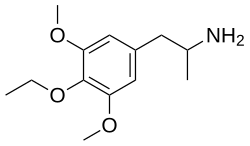
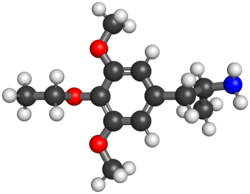
3C-E, also known as 4-ethoxy-3,5-dimethoxyamphetamine or α-methylescaline, is a synthetic psychedelic in the 3C family. It is the alpha-methylated analogue of escaline, with an ethoxy group at the 4-position of the aromatic ring. Laboratory studies have found activity at serotonin receptors and psychedelic-like responses in animal models, but controlled human research is lacking.
Chemistry and relationship to escaline
3C-E belongs to the 3C-scaline group of amphetamine derivatives. Its structure contains methoxy groups at the 3- and 5-positions of the phenyl ring, an ethoxy group at the 4-position and an alpha-methyl group on the side chain. It is closely related to Allylescaline and 3C-P, which differ in the substituent at the 4-position.
The “3C” designation distinguishes these alpha-methylated amphetamine derivatives from the corresponding two-carbon phenethylamines, often called scalines.
Pharmacology
A 2022 study examined 3C-E alongside other scalines and 3C-scalines in receptor assays. 3C-E bound to the 5-HT2A receptor in the micromolar range and acted as a full agonist in the functional assay. It also showed partial agonist activity at 5-HT2B, while the tested compounds showed no potent affinity for dopamine receptors or monoamine transporters (Kolaczynska and colleagues, 2022).
Earlier animal research found that 3C-E produced a head-twitch response, a behavioural model associated with 5-HT2A-mediated psychedelic activity. The 2022 paper notes that 3C-E and 3C-P produced this response with nearly identical potency in the referenced experiment. These results support psychedelic potential but do not establish human potency or clinical effects.
Subjective effects
The PsychonautWiki profile of 3C-E is based mainly on historical descriptions and anecdotal reports. Reliable human evidence is too limited to establish a typical experience or make firm comparisons with mescaline, escaline or other 3C compounds.
Descriptions associated with the broader mescaline-derived phenethylamine group include visual changes, altered thought and emotional shifts. Such general similarities should not be mistaken for compound-specific clinical observations.
Toxicity and research limitations
No detailed clinical case series has established the acute toxicity, metabolism or long-term effects of 3C-E. The available pharmacology is based on receptor assays and animal behaviour. There are no controlled human studies that establish dependence potential or a clinical safety profile.
The partial activity reported at 5-HT2B is a laboratory finding. It does not demonstrate a particular cardiac outcome in humans, although it is a target that researchers monitor when assessing long-term safety.
Related compounds
3C-E is related to 3C-P, Allylescaline, Escaline and 2C-E. It is the alpha-methylated analogue of escaline and differs from 3C-P by its shorter ethoxy substituent.
Reviews
There are no reviews yet.