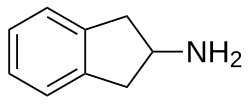
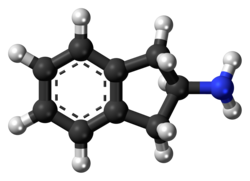
2-Aminoindane (2-AI) is a synthetic stimulant belonging to the aminoindane family. It is structurally related to amphetamine, but its side chain is incorporated into a five-membered ring fused to the benzene ring. 2-AI has appeared in products sold as party drugs and research chemicals. Its pharmacology has not been studied extensively, and there are no controlled human studies establishing its effects or safety.
Chemistry
2-AI is the unsubstituted member of the aminoindane group. Its structure consists of an indane ring system with an amino group attached at the 2-position. It is related to amphetamine and to N-methyl-2-aminoindane (NM-2-AI), which carries an additional methyl group on the nitrogen.
Aminoindanes are sometimes discussed alongside amphetamines and synthetic cathinones because of their stimulant properties, but they are a separate chemical family. 2-AI does not contain the β-keto group that defines a cathinone.
Pharmacology
The precise mechanism of 2-AI has not been established. Its stimulant effects are generally attributed to an influence on dopamine and norepinephrine signalling, but the available evidence is not sufficient to describe its activity at monoamine transporters in detail. Earlier descriptions of its pharmacology were largely inferred from its structure and from comparisons with amphetamine-like stimulants.
A 2025 study published the first dedicated toxicity assessment of 2-AI and NM-2-AI. The researchers used several computational models to predict acute toxicity, organ effects, genotoxicity and cardiotoxicity. The models flagged possible cardiovascular and pulmonary concerns, but these are predictions rather than findings from animal experiments or clinical observations (Jurowski and Frydrych, 2026).
Subjective effects
The PsychonautWiki profile of 2-AI describes stimulant effects but notes that direct pharmacological research is lacking and its own index contains no experience reports. The effects below come from anecdotal accounts rather than controlled human studies.
Physical effects
Stimulation is the most frequently described effect. Reports compare it with amphetamine, with increased energy and a tendency towards physical restlessness. Accounts of stronger effects describe jaw clenching, involuntary shaking and a vibrating sensation in the body. These effects may interfere with fine motor control.
Other reported physical effects include increased heart rate, sweating, reduced appetite, dehydration and nausea. Some accounts mention pain suppression and temporary sexual difficulties. The frequency of these reactions is unknown.
Cognitive effects
Users describe increased wakefulness, focus, motivation and faster thinking. Euphoria and greater appreciation of music are also reported. Some accounts describe improved concentration at lower subjective intensity, while stronger stimulation can become distracting and make it harder to organise thoughts.
Compulsive redosing is mentioned in user reports. Anxiety, irritability, cognitive fatigue and low mood may appear as the effects wear off. It is unclear how consistently these effects occur.
Toxicity and research limitations
The acute and long-term toxicity of 2-AI in humans remains largely unknown. A UNODC overview of aminoindanes notes that human effects had not been adequately documented, while animal and in-vitro findings could not establish a human safety profile. The newer 2025 toxicity paper adds computational predictions, not clinical evidence.
As a stimulant, 2-AI may place strain on the cardiovascular system, particularly when combined with other stimulants. However, the magnitude of this risk has not been measured in controlled studies. Dependence, withdrawal and long-term neurological effects also remain insufficiently studied.
Related compounds
2-AI is related to NM-2-AI and other aminoindanes, including MDAI and 5-IAI. It is structurally related to amphetamine, but belongs to a separate chemical family.

Reviews
There are no reviews yet.