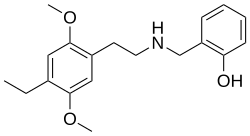
25E-NBOH, also known as 2C-E-NBOH, is a synthetic psychedelic in the N-benzylphenethylamine family. It is an N-(2-hydroxybenzyl) derivative of 2C-E, with an ethyl group at the 4-position of the phenyl ring. It has been identified in seized blotter papers and in a clinical intoxication case. Research on its pharmacology remains limited, but recent work has begun to describe its metabolism in detail.
Chemistry and identification
25E-NBOH is based on the 2C-E phenethylamine structure, with methoxy groups at the 2- and 5-positions and an ethyl group at the 4-position of the phenyl ring. Its nitrogen is connected to a 2-hydroxybenzyl group. This distinguishes it from 25E-NBOMe, which carries a 2-methoxybenzyl substituent.
25E-NBOH was identified in blotter papers seized in Brazil between 2017 and 2018, alongside 25B-NBOH and 25C-NBOH. The structures were confirmed using mass spectrometry and nuclear magnetic resonance (Machado and colleagues, 2020).
Pharmacology
NBOH compounds are related to the 2C-series psychedelics and are associated with serotonin 5-HT2A receptor agonism. The hydroxybenzyl substitution can increase receptor affinity in this chemical family. However, a full receptor-binding and functional profile specific to 25E-NBOH has not yet been established.
Reported effects
The PsychonautWiki profile of 25E-NBOH describes it as a psychedelic. Human evidence is limited, with too little controlled information to establish characteristic visual, cognitive or emotional effects.
As a 2C-E-derived NBOH compound, psychedelic effects are pharmacologically plausible. Detailed descriptions of other NBOH or NBOMe substances, however, are not direct observations of 25E-NBOH.
Clinical intoxication
A 2024 case report described a 23-year-old man who developed serotonin syndrome and loss of consciousness after using a powder labelled as 25I-NBOH. Toxicological analysis identified 25E-NBOH and MDPHP; 25I-NBOH was not detected. Because MDPHP was also present, the clinical presentation cannot be attributed to 25E-NBOH alone. The report nevertheless provides the first analytically confirmed clinical evidence of human exposure to 25E-NBOH (Pelletier and colleagues, 2024).
Metabolism and research limitations
A 2026 study examined 25E-NBOH metabolism in human liver microsomes, rat urine and a fungal model. The researchers annotated 56 metabolites and identified pathways including hydroxylation, O-demethylation and N-debenzylation, followed by conjugation. Several metabolites were confirmed with synthesised reference standards, providing potential markers for forensic detection (Vágnerová and colleagues, 2026).
Despite this progress in analytical research, there are still no controlled human pharmacology studies defining its duration, acute toxic range or long-term effects. The clinical case involved another stimulant, so the independent contribution of 25E-NBOH remains uncertain.
Related compounds
25E-NBOH is related to 25B-NBOH, 25C-NBOH and 25D-NBOMe. It is the NBOH analogue of 2C-E, while 25E-NBOMe has a different N-benzyl substituent.
Reviews
There are no reviews yet.