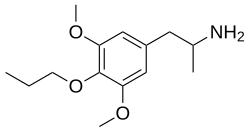
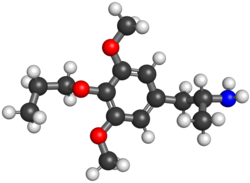
3C-P, also known as 4-propoxy-3,5-dimethoxyamphetamine or α-methylproscaline, is a synthetic psychedelic in the 3C-scaline family. It is the alpha-methylated analogue of proscaline and is structurally related to mescaline-derived phenethylamines. Laboratory research has confirmed activity at serotonin 5-HT2A receptors, but there is very little controlled information about its effects or toxicity in humans.
Chemistry
3C-P contains methoxy groups at the 3- and 5-positions of the aromatic ring and a propoxy group at the 4-position. Its side chain carries an alpha-methyl group, making it an amphetamine derivative rather than a two-carbon phenethylamine. It is related to 3C-E, which has an ethoxy substituent, and Allylescaline, which has an allyloxy group but lacks the alpha-methyl group.
Pharmacology
A 2022 in-vitro study found that 3C-P binds to the 5-HT2A receptor with micromolar affinity and acts as a full agonist in the functional assay. It also showed limited interaction with several non-serotonergic targets and did not potently bind to human monoamine transporters. The study placed 3C-P among mescaline-related compounds with activity at 5-HT2A and 5-HT2C receptors (Kolaczynska and colleagues, 2022).
The same paper discusses a head-twitch response in mice, a behavioural model used to investigate psychedelic activity. 3C-P produced a response with potency similar to 3C-E in the cited experiment. These animal findings do not establish a human effect profile.
Subjective effects
The PsychonautWiki profile of 3C-P notes how little information is available. Detailed reports are scarce, and no controlled human study has established its characteristic visual, cognitive or physical effects.
Its receptor activity is consistent with psychedelic potential. However, effects described for proscaline, 3C-E or other mescaline derivatives should not be assumed to apply directly to 3C-P.
Toxicity and research limitations
Published research on 3C-P includes no detailed human intoxication series, pharmacokinetic study or long-term safety assessment. The available evidence consists mainly of chemical characterisation, receptor assays and animal behavioural research.
The reported 5-HT2A activity supports its classification as a serotonergic psychedelic, but does not establish its potency in humans or the likelihood of serious adverse reactions. Dependence potential and chronic effects remain unknown.
Related compounds
3C-P is related to 3C-E, Proscaline, Allylescaline and Mescaline. It is the alpha-methylated analogue of proscaline.
Reviews
There are no reviews yet.