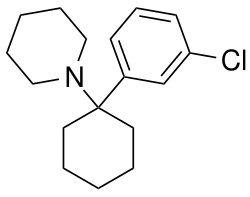
3-Chlorophencyclidine (3-Cl-PCP) is a synthetic dissociative of the arylcyclohexylamine family. It is a positional analogue of phencyclidine (PCP), with a chlorine atom attached to the 3-position of the phenyl ring. The compound was identified in Europe as a new psychoactive substance in 2021, but there is very little experimental information about its pharmacology or effects in humans.
Chemistry and identification
3-Cl-PCP retains the characteristic PCP structure: a phenyl ring and a piperidine ring attached to the same carbon of a cyclohexyl group. The chlorine substituent is located at the meta position of the phenyl ring. It is therefore structurally related to 3-MeO-PCP and 3-HO-PCP, although the substituent on the aromatic ring is different.
The European Monitoring Centre for Drugs and Drug Addiction formally notified the substance in January 2021 after Slovenian authorities identified it in a seizure. The notification gives the chemical name 1-[1-(3-chlorophenyl)cyclohexyl]piperidine and classifies it as an arylcyclohexylamine (EU Early Warning System notification, 2021).
Pharmacology
Like other PCP derivatives, 3-Cl-PCP is expected to act primarily as an NMDA receptor antagonist. However, this classification is based largely on its chemical structure and the known activity of related arylcyclohexylamines. A detailed receptor-binding profile has not been established, and there is no sound basis for assigning it the same potency or secondary targets as PCP or 3-MeO-PCP.
Reported effects
The available descriptions are largely anecdotal. The PsychonautWiki entry for 3-Cl-PCP also identifies its subjective-effects section as incomplete, so the reported profile should be treated cautiously.
Physical effects
Reports describe a mixture of stimulation and sedation, with sedation appearing more prominent in some accounts. Muscle soreness, flu-like symptoms and increased cardiovascular activity have also been mentioned. These reports are not supported by clinical studies and do not establish how frequently such reactions occur.
Cognitive and sensory effects
Reported effects include dissociation, changes in the sense of time, altered thought organisation and memory suppression. Some accounts mention euphoria, disinhibition and increased immersion, while others describe confusion, delusional thinking or psychotic symptoms. Visual reports include reduced acuity, double vision, altered perspective and internal imagery. Auditory distortions and hallucinations are also listed.
Reliable accounts are too scarce to tell whether these effects are typical or confined to a few individual experiences.
Toxicity and research limitations
No controlled human studies have established the toxicity, metabolism or long-term effects of 3-Cl-PCP. The suggestion that its chlorine substituent may make it harder for the body to break down is speculative; it should not be presented as an established metabolic finding.
Early user reports have raised concerns about physical discomfort, cardiovascular effects and psychosis, but the number and quality of reports are limited. There is currently no reliable clinical profile with which to compare 3-Cl-PCP directly with other PCP derivatives.
Related compounds
3-Cl-PCP is structurally related to PCP, 3-MeO-PCP and 3-HO-PCP. These compounds share the phencyclidine framework but differ in the substituent attached to the phenyl ring. Their pharmacological properties should not be assumed to be identical.

Reviews
There are no reviews yet.