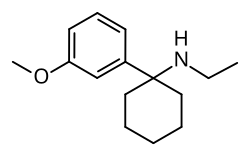
3-Methoxyeticyclidine (3-MeO-PCE) is a synthetic dissociative in the arylcyclohexylamine family. It is an N-ethyl analogue of phencyclidine (PCP), with a methoxy group at the 3-position of the phenyl ring. It is known for combining dissociation with pronounced stimulation, and laboratory studies have found activity at both NMDA receptors and the serotonin transporter.
Chemistry and history
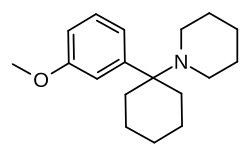
3-MeO-PCE has a cyclohexylamine core, an N-ethyl substituent and a methoxy group on the meta position of the aromatic ring. It is structurally related to 3-MeO-PCP, but the ethyl group replaces the piperidine ring found in PCP derivatives. It is also related to 3-HO-PCE, which has a hydroxy group instead of methoxy.
The compound began appearing on the research-chemical market around 2010. It was sold as a dissociative alternative to ketamine and PCP analogues, although its effects and risks were not well characterised at the time.
Pharmacology
3-MeO-PCE acts primarily as an NMDA receptor antagonist. A 2013 receptor-screening study measured a binding affinity of 61 nM at the NMDA PCP site. The same study found affinity at the serotonin transporter (SERT) of 115 nM, along with weaker binding at sigma-2 receptors. Its SERT affinity was notable among the compounds included in the study (Roth and colleagues, 2013).
These findings help explain why 3-MeO-PCE is often described as more stimulating than ketamine. They do not, by themselves, establish how much each target contributes to the subjective effects.
Subjective effects
The PsychonautWiki profile of 3-MeO-PCE emphasises stimulation alongside dissociation. Many of these descriptions are anecdotal; the source also raises concerns about mania, delusions and psychosis.
Physical effects
Stimulation is often described as unusually strong for a dissociative. Users report increased energy, bodily lightness, restless legs and a sharp, spreading physical sensation. Physical euphoria and warmth are also mentioned, particularly in less intense experiences. As the effects intensify, these sensations may give way to motor impairment and physical disconnection.
Other reported effects include reduced appetite, nausea suppression, pain relief, dizziness, increased blood pressure and heart rate, sweating and difficulty urinating. Respiratory depression and seizures are listed among possible adverse effects.
Visual effects
Some reports describe sharper visual acuity and stronger colour perception. These enhancements can give way to double vision, reduced frame rate and impaired pattern recognition. Perspective distortions, environmental cubism and scenery slicing are also described.
Geometric imagery is often characterised as dark, fine and made up of small interlocking lines. Internal hallucinations may include imagined environments, landscapes or scenes. The content and intensity vary between reports.
Cognitive and emotional effects
Reported effects include cognitive euphoria, conceptual thinking, creativity, increased appreciation of music and changes in the perception of time. Disinhibition and anxiety suppression may also occur. The stimulating quality can make the experience feel mentally active, although memory suppression and disorganised thinking are reported at greater intensity.
Mania, delusions and psychosis are recurring concerns in reports involving heavy or repeated use. Some users describe compulsive redosing, which may prolong the experience and increase the likelihood of severe confusion or behavioural disturbance.
Auditory and dissociative effects
Auditory effects include altered sound perception, suppression and occasional hallucinations. Tactile, visual and consciousness disconnection may develop as the dissociation becomes more pronounced. Some reports describe a sense of unity or interconnectedness, while others focus on detachment and memory loss.
Metabolism and clinical reports
A 2024 study examined 3-MeO-PCE metabolism using human liver microsomes, a zebrafish model and urine samples from forensic cases. Fourteen metabolites were identified, with pathways including hydroxylation, O-demethylation, N-dealkylation, dehydrogenation and conjugation. The findings may help laboratories identify exposure in biological samples (Xu and colleagues, 2024).
Serious intoxications have also been documented. A 2021 fatal case involved 3-MeO-PCE together with 2-FDCK, 5-MeO-DMT, amphetamine, cocaine and cannabis. The authors attributed the death to a combined drug effect, with 2-FDCK considered the main contributor; the case cannot establish the isolated toxicity of 3-MeO-PCE (Gicquel and colleagues, 2021).
A more recent forensic report detected 3-MeO-PCE and its metabolite 3-HO-PCE in a fatal fall involving alcohol and tramadol. The authors considered acute agitation or dissociation a possible contributor to the circumstances, while the immediate cause of death was traumatic injury (Forensic case report, 2026).
Toxicity and dependence
There is no well-defined human toxic range for 3-MeO-PCE. Published cases show that severe behavioural disturbance and fatal outcomes can occur in complex polydrug settings, but they do not isolate the contribution of the compound in each case. Repeated use is associated in user reports with tolerance, compulsive redosing, mania and psychotic symptoms.
Related compounds
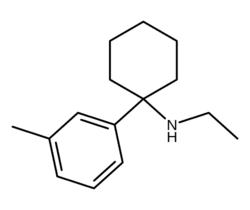
3-MeO-PCE is related to 3-MeO-PCP, 3-HO-PCE and 3-HO-PCP. Its receptor profile differs from these analogues, particularly in the measured affinity at the serotonin transporter.

Reviews
There are no reviews yet.