
PX-3, also known as APP-CHMINACA, is a synthetic cannabinoid in the indazole-3-carboxamide family. It was originally developed as a potential pharmaceutical compound and later appeared in forensic investigations of new psychoactive substances. Laboratory research identifies it as a potent agonist at CB1 and CB2 receptors. More recent work has focused on its metabolism and the markers needed to confirm exposure in biological samples.
Chemistry and identification
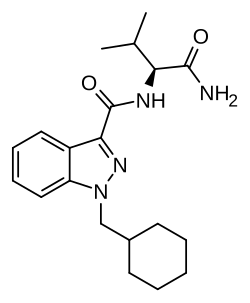
APP-CHMINACA contains an indazole core linked to an amino-acid-derived carboxamide group and a cyclohexylmethyl substituent. Its full structure is N-[(2S)-1-amino-1-oxo-3-phenylpropan-2-yl]-1-(cyclohexylmethyl)-1H-indazole-3-carboxamide. The abbreviation PX-3 is used for this compound in forensic and analytical literature. It should not be confused with PX-2, which is a different fluorinated indazole carboxamide.
The compound was first synthesised in pharmaceutical research as part of work on indazole derivatives. It was subsequently identified in seized material in Europe, including a powder initially labelled as a non-psychoactive product. Analytical characterisation used complementary mass-spectrometric and spectroscopic methods (Systematic analytical characterisation of new psychoactive substances, 2016).
Pharmacology
APP-CHMINACA is a potent agonist at the CB1 and CB2 receptors. A recent metabolic study summarises earlier receptor data reporting binding affinities in the low-nanomolar range, with the (S)-enantiomer showing substantially greater CB1 activity than the corresponding (R)-enantiomer. This stereochemical difference is important: the two forms should not be assumed to have equivalent pharmacological activity (Camuto and colleagues, 2025).
As with other high-efficacy synthetic cannabinoid receptor agonists, activation of CB1 can produce effects that differ from those of THC, which generally behaves as a partial agonist. Receptor potency alone, however, does not predict the severity of an individual intoxication.
Metabolism
A 2025 study combined human and mouse liver microsome experiments with administration studies in mice. Researchers identified eight metabolic reactions organised around two main pathways. The predominant route involved hydrolysis of the distal amide group, followed by hydroxylation of the cyclohexylmethyl portion of the molecule. A second route involved multiple hydroxylations of the parent compound and subsequent reduction.
In blood, unchanged APP-CHMINACA and products of distal-amide hydrolysis were among the more prominent findings. In urine, hydroxylated products of the hydrolysis metabolite were the more useful longer-term markers. These results are relevant to forensic testing, where the parent compound may not be the best target after metabolism (Camuto and colleagues, 2025).
Reported effects and clinical evidence
There is limited compound-specific clinical information for PX-3. Its receptor activity supports a potent cannabimimetic mechanism, but the available literature does not establish a reliable human subjective profile or a characteristic duration. Reports involving other indazole carboxamides offer no direct evidence about APP-CHMINACA.
Clinical concerns associated with potent synthetic cannabinoid agonists include altered mental status, agitation, confusion, seizures and cardiovascular disturbances. These are class-level concerns; the available PX-3 literature does not provide enough analytically confirmed cases to quantify how often any particular reaction occurs.
Toxicity and research limitations
The laboratory pharmacology and metabolism of PX-3 are better understood than its clinical effects. There is no well-established human toxic range, and controlled studies of dependence or long-term effects are lacking. The 2025 metabolism study improves detection of exposure, without assessing clinical safety.
Related compounds
PX-3 is related to PX-2, AB-CHMINACA and other indazole-carboxamide synthetic cannabinoids. Its cyclohexylmethyl substituent and phenylalanine-derived amide group distinguish it from the related fluorinated compounds.
Reviews
There are no reviews yet.