
STS-135, also known as 5F-APICA, is a synthetic cannabinoid in the adamantyl-indole carboxamide family. It is the terminally fluorinated analogue of APICA and acts as an agonist at CB1 and CB2 receptors. STS-135 has been identified in herbal products and forensic seizures. Laboratory studies have examined its receptor activity and extensive metabolism, while post-mortem reviews have recorded it in fatal synthetic cannabinoid cases.
Chemistry and identification
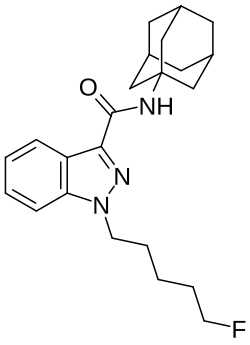
STS-135 is N-(adamantan-1-yl)-1-(5-fluoropentyl)-1H-indole-3-carboxamide. It contains an indole core, a 5-fluoropentyl chain attached to the indole nitrogen and an adamantyl group connected through a carboxamide. It differs from 5F-AKB48, which has an indazole core, and from APICA, which has an unfluorinated pentyl chain.
The compound was detected in herbal incense products and police seizures. Its structure was confirmed in forensic and analytical work, and it is included in international methods for identifying synthetic cannabinoid receptor agonists.
Pharmacology
STS-135 acts as an agonist at CB1 and CB2 receptors. A comparative study of fluorinated synthetic cannabinoids found that STS-135 activated both receptor subtypes in vitro. Terminal fluorination generally increased CB1 potency relative to the corresponding non-fluorinated compounds, although the same pattern was not consistent across the animal telemetry results (Banister and colleagues, 2015).
Another study found that STS-135 had measurable CB1 affinity and agonist efficacy, although its potency was lower than that of some newer high-affinity compounds such as 5F-PB-22. The compound also increased dopamine levels in the nucleus accumbens shell in animal experiments, an effect blocked by a CB1 antagonist (Native CB1 receptor affinity and stimulant properties of third-generation cannabinoids, 2015).
Metabolism
Human hepatocyte research found that STS-135 is extensively metabolised. The major metabolites were mono- and dihydroxylated products formed on the adamantane group. In human liver microsomes, the compound showed an in-vitro half-life of approximately 3.1 minutes under the study conditions, indicating rapid metabolism in that experimental system (Wohlfarth and colleagues, 2015).
The study proposed several metabolites as targets for forensic testing. This is important because the parent compound may be difficult to detect in urine after extensive metabolism.
Reported effects and clinical concerns
Little clinical information distinguishes the effects of STS-135 from those of other synthetic cannabinoids. Animal studies demonstrate cannabimimetic effects, while post-mortem reviews have identified STS-135 in fatality investigations. These findings establish its forensic relevance, without reliably describing its subjective effects in humans.
Clinical effects associated with potent synthetic cannabinoid products include altered consciousness, agitation, seizures and cardiovascular complications. Mixed products and co-exposures frequently complicate the interpretation of individual cases.
Toxicity and research limitations
STS-135 has a documented receptor and metabolic profile, but its human toxic range, dependence potential and long-term effects remain poorly characterised. The presence of STS-135 in post-mortem investigations does not mean it was the sole cause of death in every case; other substances may be involved.
Related compounds
STS-135 is related to APICA, 5F-AKB48 and 5F-PB-22. It is the 5-fluoropentyl analogue of APICA.
Reviews
There are no reviews yet.