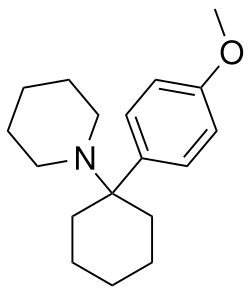
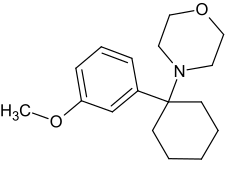
4-Methoxyphencyclidine (4-MeO-PCP), also known as methoxydine, is a synthetic dissociative in the arylcyclohexylamine family. It is a methoxy-substituted analogue of phencyclidine (PCP), with the methoxy group at the 4-position of the phenyl ring. It was one of the first PCP-derived research chemicals sold online, although its subjective effects and toxicity have never been studied extensively.
History and chemistry
The synthesis of 4-MeO-PCP was first reported in 1965 by Parke-Davis chemist Victor Maddox during work on PCP analogues. It later appeared on the online research-chemical market in 2008, before several related dissociatives became widely available.
4-MeO-PCP retains the piperidine and cyclohexyl framework of PCP, with a methoxy group attached to the para position of the phenyl ring. It is a positional isomer of 3-MeO-PCP, which carries the methoxy group at the meta position.
Pharmacology
4-MeO-PCP acts as an NMDA receptor antagonist. A receptor-screening study measured a binding affinity of 404 nM at the NMDA PCP site. In the same assay, PCP showed stronger affinity at 59 nM, while ketamine showed weaker affinity at 659 nM. The study also detected binding at the serotonin transporter, norepinephrine transporter and sigma receptors (Roth and colleagues, 2013).
These results place 4-MeO-PCP between PCP and ketamine in that particular NMDA binding assay. Receptor affinity does not directly predict subjective potency, and the results do not establish a complete mechanism for its effects in humans.
Subjective effects
The PsychonautWiki profile of 4-MeO-PCP offers a brief description of effects and marks that section as incomplete. There are no experience reports in its own index, so the available profile is much less developed than those of some other PCP analogues.
Physical effects
Reported physical effects include dizziness, nausea, bodily lightness, physical euphoria and spontaneous physical sensations. Motor control may become impaired, with spatial disorientation and reduced awareness of touch. Some accounts describe physical autonomy, while others report a loss of coordination.
Visual effects
Visual suppression is a recurring part of the reported profile. It may involve reduced acuity, double vision, impaired pattern recognition and a perceived reduction in visual frame rate. Perspective distortions, environmental cubism and scenery slicing are also listed. Internal imagery and more elaborate hallucinatory scenes have been described, but the available reports are sparse.
Cognitive effects
There is little reliable information about the cognitive effects of 4-MeO-PCP. Dissociation, altered perception and confusion are consistent with its NMDA receptor activity, but the available user reports do not support a detailed or predictable psychological profile.
Toxicity and research limitations
The long-term effects and toxic range of 4-MeO-PCP have not been established in clinical studies. The limited history of human use and the small number of detailed experience reports make it difficult to assess dependence, psychiatric effects or the likelihood of serious poisoning.
Its receptor-binding profile is better documented than its human toxicology. Reports of different apparent potencies in grey-market samples have also raised questions about purity and the presence of synthesis-related impurities. Such variability makes anecdotal comparisons difficult to interpret.
Related compounds
4-MeO-PCP is related to PCP, 3-MeO-PCP and other methoxy-substituted arylcyclohexylamines. The position of the methoxy group distinguishes the 3- and 4-isomers and is associated with measurable differences in receptor affinity.
Reviews
There are no reviews yet.