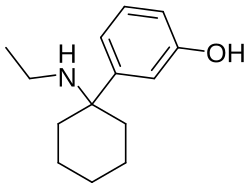
3-Hydroxyeticyclidine (3-HO-PCE) is a synthetic dissociative in the arylcyclohexylamine family and a hydroxy-substituted analogue of eticyclidine (PCE). Its structure resembles that of 3-MeO-PCE, but it carries a hydroxy group rather than a methoxy group at the 3-position of the phenyl ring. Research has begun to clarify its metabolism and receptor activity, although its effects and toxicity in humans remain poorly understood.
Chemistry
3-HO-PCE contains the cyclohexylamine framework of PCE, with an ethyl group attached to the nitrogen and a hydroxy substituent on the aromatic ring. It is structurally related to 3-MeO-PCE and 3-HO-PCP. The first differs by having a methoxy group, while the second has a piperidine ring in place of the ethylamine side chain.
Pharmacology
3-HO-PCE is expected to act as an NMDA receptor antagonist, the mechanism associated with dissociative anaesthetics such as ketamine and PCP. Earlier descriptions treated this activity as an inference from its structure. A 2025 receptor study subsequently reported measurable affinity at the NMDA receptor, with a binding value of 29.3 nM, and also observed ERK activation in its experimental model (Structure–activity study, 2025).
Possible activity at the μ-opioid receptor has also been discussed because 3-HO-PCP, a related compound, has shown opioid-receptor affinity in animal experiments. That relationship is not enough to establish opioid activity for 3-HO-PCE itself.
Subjective effects
The PsychonautWiki profile of 3-HO-PCE marks its subjective-effects section as incomplete and notes that there are no experience reports in its own index. Its descriptions are therefore preliminary, rather than an established account of the experience.
Physical effects
Physical effects are described as relatively subtle or difficult to distinguish. Difficulty urinating is listed, while seizures are mentioned as a possible adverse event, particularly under physically stressful conditions. How often either effect occurs is unknown.
Dissociative effects
Reports describe tactile, visual and consciousness disconnection, although these effects are said to be less prominent than with ketamine or methoxetamine. More complete dissociation may occur in intense experiences, but there is little direct reporting to describe its character reliably.
Cognitive and sensory effects
The listed cognitive effects include conceptual thinking, disinhibition, cognitive euphoria, memory suppression and changes in the perception of time. Mania, delusions, psychosis and compulsive redosing are also mentioned. Visual reports include reduced acuity, changes in frame rate, perspective distortions and internal imagery. Auditory suppression, distortion and hallucinations appear in the same preliminary effect list.
Metabolism and toxicology
A 2023 study examined 3-HO-PCE in human liver microsomes and biological samples. The researchers identified 15 putative metabolites: 12 formed through phase I reactions, including N-dealkylation, deamination and oxidation, and three through phase II O-glucuronidation. The work provides useful markers for forensic detection, but it does not establish the compound’s clinical safety or the effects of its metabolites (Larabi and colleagues, 2023).
There are no well-established human data on acute toxicity, dependence or long-term effects. The limited subjective reports and emerging analytical research leave substantial gaps in the understanding of this compound.
Related compounds
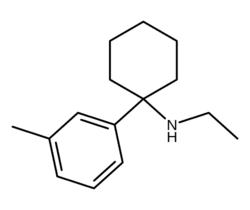
3-HO-PCE is closely related to 3-MeO-PCE, 3-HO-PCP and PCE. The hydroxy and methoxy substitutions may alter receptor activity, so the effects of one analogue cannot be used as a direct description of another.

Reviews
There are no reviews yet.