
Eticyclidine, commonly known as PCE or CI-400, is a synthetic dissociative anaesthetic in the arylcyclohexylamine family. It is closely related to phencyclidine (PCP), but has an ethyl group attached to the nitrogen instead of PCP’s piperidine ring. PCE was investigated as an anaesthetic in the late 1950s, but its clinical development was abandoned after reports of pronounced hallucinations and behavioural disturbances.
History and chemistry
PCE was developed by Parke-Davis during the search for dissociative anaesthetics related to PCP. Early clinical work found that it could produce analgesia and a marked alteration of awareness, but the effects were difficult to manage. The discovery of ketamine, which had a more favourable clinical profile, further reduced interest in PCE as a medicine (Mion, 2017).
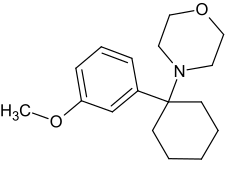
Its structure consists of a phenyl ring and a cyclohexyl group attached to an ethylamine chain. This distinguishes it from PCP, where the nitrogen is incorporated into a piperidine ring. PCE is also the parent structure for compounds such as O-PCE and 3-MeO-PCE.
Pharmacology
PCE acts primarily as a non-competitive NMDA receptor antagonist. By blocking the NMDA channel, it disrupts excitatory glutamate signalling and can produce analgesia, anaesthesia and dissociation. This mechanism is shared with PCP and ketamine, although the compounds differ in their pharmacological profiles (Domino, 1992).
Some pharmacological accounts also describe effects on monoamine reuptake, which may contribute to the stimulating and euphoric qualities reported by users. The available evidence does not provide a modern, comprehensive comparison of PCE’s activity at all relevant transporters and receptors.
Subjective effects
The PsychonautWiki profile of PCE describes dissociation accompanied by more stimulation and behavioural changes than are commonly associated with ketamine. The subjective-effects section is incomplete, and much of the description rests on anecdotal reports.
Physical effects
Reported effects include stimulation, analgesia, dizziness, nausea and loss of motor coordination. Some accounts describe bodily lightness and a sense of physical detachment. The compound has also been associated with an unpleasant taste and nausea, features noted in historical descriptions of PCE.
Cognitive and sensory effects
Dissociation is accompanied in reports by changes in perception, memory and the sense of time. Users may describe a dream-like or detached state, while stronger experiences can involve confusion, hallucinations and an inability to interact normally with the surroundings.
Mania, delusional thinking and psychosis are particular concerns in reports involving PCE. These reactions have been described as more prominent than with some other dissociatives, although the available reports do not establish a precise rate of occurrence.
Toxicity and clinical concerns
PCE was not adopted for routine human anaesthesia because its dissociative and hallucinogenic effects were difficult to control. The clinical experience with early PCP-related compounds helped motivate the development of ketamine, which was better tolerated in medical settings.
Modern clinical data on recreational PCE exposure are sparse. The broader review of arylcyclohexylamine intoxications notes that these compounds can differ substantially in potency, duration and toxicity, even when they share NMDA receptor antagonism (Arylcyclohexylamine derivatives: pharmacokinetic, pharmacodynamic, clinical and forensic aspects, 2022).
There is no well-established human toxic range for PCE, and its long-term effects have not been characterised in controlled studies. The historical anaesthetic data should not be taken as evidence that non-medical exposure is predictable or safe.
Related compounds
Eticyclidine is related to PCP, O-PCE, 3-MeO-PCE and 3-HO-PCE. These compounds share the PCE or PCP framework but differ in their nitrogen substituents and aromatic-ring modifications.

Reviews
There are no reviews yet.