
Hydroxetamine (HXE), also known as 3-HO-2′-oxo-PCE, is a synthetic dissociative in the arylcyclohexylamine family. It is structurally related to methoxetamine (MXE), but has a hydroxy group rather than a methoxy group at the 3-position of the phenyl ring. HXE appeared on the research-chemical market around 2020, and information about its pharmacology and toxicity remains limited.
Chemistry
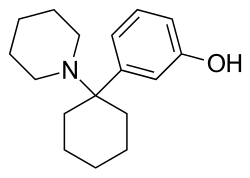
HXE has the cyclohexanone and N-ethylamine structure found in MXE. Its distinguishing feature is the hydroxy substituent on the aromatic ring. It is important not to confuse HXE with 3-HO-PCE: HXE contains a ketone group on the cyclohexane ring, whereas 3-HO-PCE does not. The two are related, but they are different compounds.
A forensic monograph identifies HXE as 2-(ethylamino)-2-(3-hydroxyphenyl)cyclohexan-1-one and places it among novel dissociatives structurally related to MXE and O-PCE (CFSRE, Hydroxetamine monograph).
Pharmacology
There is little direct research on HXE. Its classification as a dissociative is based on its structure and the known pharmacology of related arylcyclohexylamines. It is expected to act as an NMDA receptor antagonist, but a detailed receptor-binding profile has not been established.
The hydroxy group may also affect the compound’s metabolism and distribution compared with MXE. Human pharmacokinetic data are still too limited to establish these differences.
Subjective effects
The available PsychonautWiki profile of HXE is marked as incomplete, and its experience index contains no submitted reports. Its effect descriptions are therefore based on a small number of anecdotal accounts rather than systematic observation.
Physical effects
Reports describe a mixture of mild stimulation and sedation. Some users mention a warm or slightly rough bodily sensation, a feeling of lightness and reduced tactile awareness. As dissociation becomes stronger, motor coordination may deteriorate and spatial disorientation can develop. Nausea and dizziness are also listed.
Visual effects
Reported visual changes include reduced acuity, double vision, difficulty recognising patterns and changes in the apparent frame rate of moving objects. Perspective distortions and altered environmental geometry are also described. More complex internal or external imagery appears less consistently.
Cognitive and dissociative effects
Descriptions include cognitive euphoria, introspection, conceptual thinking, changes in time perception and memory suppression. Some reports characterise HXE as relatively clear-headed and comfortable compared with ketamine or more chaotic dissociatives such as O-PCE. Others mention confusion, depersonalisation and a strong sense of separation from the body and surroundings.
Toxicity and research limitations
The toxicity and long-term health effects of HXE have not been adequately studied. The forensic monograph establishes the compound’s chemical identity, without assessing its clinical safety. There is no established toxic range, and reports of adverse effects are too limited to determine their frequency.
Claims about tolerance, dependence or interactions are also based mainly on analogy with other NMDA antagonists. They should not be mistaken for findings from controlled studies of HXE itself.
Related compounds
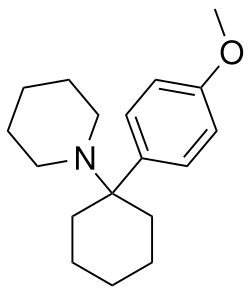
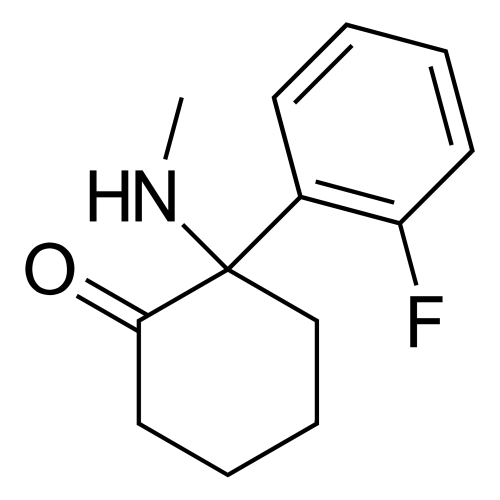
HXE is related to Methoxetamine, O-PCE, 3-HO-PCE and MXPr. Its hydroxy substitution distinguishes it from MXE, while its ketone group distinguishes it from 3-HO-PCE.

Reviews
There are no reviews yet.