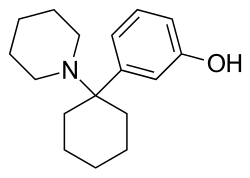
3-Hydroxyphencyclidine (3-HO-PCP) is a synthetic dissociative of the arylcyclohexylamine family and a hydroxy-substituted analogue of phencyclidine (PCP). It is known for its activity at NMDA receptors and has also shown affinity for opioid receptors in laboratory studies. The significance of this second activity in humans is uncertain, and the compound’s clinical safety profile remains poorly defined.
History and chemistry
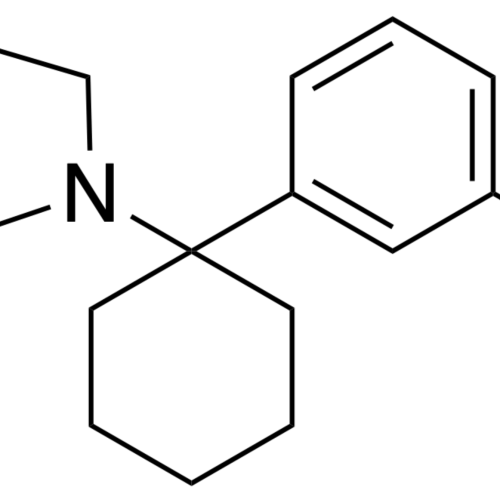
3-HO-PCP was first synthesised in 1978 during research into the structure–activity relationships of PCP derivatives. Its structure retains the piperidine and cyclohexyl framework of PCP, with a hydroxy group at the 3-position of the phenyl ring.
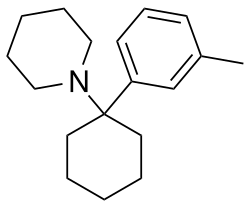
The hydroxy substitution distinguishes it from 3-MeO-PCP, which carries a methoxy group at the same position. It is also related to 3-HO-PCE, which has an ethylamine side chain rather than the piperidine ring found in 3-HO-PCP.
Pharmacology
3-HO-PCP acts as an NMDA receptor antagonist. Binding studies have found high affinity at the PCP site of the NMDA receptor, in some assays greater than that of PCP itself. This activity is consistent with its dissociative and anaesthetic effects.
The compound is unusual among dissociatives because it has also shown affinity for opioid receptor sites. An early study found that 3-hydroxyphencyclidine interacted with morphine-sensitive binding sites in rat brain tissue and produced opioid-related effects in animal preparations (Itzhak, Kalir and Sarne, 1981). Later summaries describe μ-opioid receptor activity in animal models. These findings do not demonstrate that 3-HO-PCP produces clinically meaningful opioid effects in humans.
Subjective effects
The PsychonautWiki profile of 3-HO-PCP draws mainly on user accounts of dissociative, stimulating and euphoric effects. Its subjective-effects and toxicity sections are marked as incomplete.
Physical effects
Reports describe stimulation and sedation, sometimes alternating during the experience. Bodily lightness, restless legs and spontaneous physical sensations are also mentioned. Physical euphoria is reported more often than with some other dissociatives, while tactile enhancement may give way to tactile suppression and numbness as the dissociative effects become stronger.
Other reported effects include pain relief, impaired motor control, spatial disorientation, dizziness, increased heart rate and blood pressure, sweating and dehydration. Respiratory depression and seizures are also mentioned as possible adverse effects; their frequency is unknown.
Cognitive effects
Some accounts describe cognitive euphoria, disinhibition, conceptual thinking and increased immersion. Changes in memory and time perception are also reported. At the less comfortable end of the spectrum, users describe confusion, disorganised thinking, delusions and psychotic symptoms. Compulsive redosing is mentioned in some reports.
Visual and auditory effects
Visual effects include reduced acuity, double vision, changes in frame rate and difficulty recognising patterns. Perspective distortions and internal imagery are also reported. Auditory suppression, distortion and hallucinations appear in the available descriptions.
Dissociation
Tactile, visual and consciousness disconnection are reported, but the source suggests that these effects may be less prominent than with ketamine or methoxetamine in some experiences. More pronounced dissociation can involve a strong sense of separation from the body and surroundings.
Toxicity and research limitations
The long-term effects and toxic range of 3-HO-PCP have not been established in controlled human research. Its opioid-receptor affinity is a particular source of uncertainty: animal binding and behavioural results cannot determine whether the compound has opioid-like effects in people or how that activity contributes to toxicity.
Reports of muscle soreness and flu-like symptoms have also appeared, but their cause is unclear. Dependence, tolerance and psychosis are concerns raised in user reports, rather than outcomes quantified in clinical studies. The lack of reliable human data makes it difficult to compare its risks with those of other PCP analogues.
Related compounds
Related substances include PCP, 3-MeO-PCP, 3-HO-PCE and 3-MeO-PCE. They share parts of the arylcyclohexylamine structure, but their receptor profiles and reported effects differ.

Reviews
There are no reviews yet.