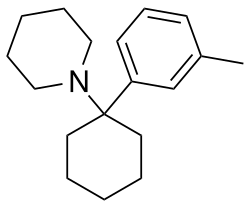
3-Methylphencyclidine (3-Me-PCP) is a synthetic dissociative of the arylcyclohexylamine family. It is a methyl-substituted analogue of phencyclidine (PCP), with the methyl group at the 3-position of the phenyl ring. It has appeared on the research-chemical market, but there is little formal research on its pharmacology, metabolism or toxicity.
Chemistry
3-Me-PCP retains the piperidine and cyclohexyl framework of PCP. The only structural change is a methyl substituent on the meta position of the phenyl ring. It is therefore distinct from 3-MeO-PCP, which carries a methoxy group at the same position, and from 3-Me-PCPy, which has a pyrrolidine ring instead of piperidine.
Pharmacology
3-Me-PCP is expected to act as an NMDA receptor antagonist, as do PCP and many related arylcyclohexylamines. However, direct receptor-binding data for the compound are scarce. A possible additional effect on monoamine transporters has been suggested by analogy with 3-Me-PCPy, but this has not been demonstrated for 3-Me-PCP itself.
The PsychonautWiki discussion page for 3-Me-PCP is not a fully approved substance article and warns that its effects and risk information may be inaccurate. Its descriptions are best treated as preliminary user reports.
Reported effects
Available accounts describe 3-Me-PCP as more stimulating and less immobilising than dissociatives such as ketamine or methoxetamine. The reported profile includes both sensory enhancement and sensory suppression, with the balance changing across the experience.
Physical effects
Users describe stimulation, bodily euphoria and a sharp, persistent body sensation. Tactile perception and bodily control may initially seem enhanced, while stronger dissociation can produce numbness, impaired coordination and loss of motor control. Pain relief and spatial disorientation are also reported.
Other reported physical effects include restless legs, dizziness, nausea suppression, increased heart rate and blood pressure, sweating and dehydration. Some accounts mention difficulty urinating and abnormal heartbeat. The frequency of these effects is not known.
Cognitive effects
Reported cognitive effects include euphoria, disinhibition, conceptual thinking, creativity and changes in memory. Mania, delusions and psychosis are also prominent in the available descriptions. Some accounts mention compulsive redosing, particularly when the onset feels subtle or the experience is underestimated.
Visual and auditory effects
Reports of milder effects describe stronger colour perception, sharper vision and increased pattern recognition. These effects may give way to double vision, reduced frame rate and difficulty processing visual information. Auditory enhancement is also reported at lower intensity, while stronger effects include sound suppression, distortion and hallucinations.
Toxicity and research limitations
The toxicity and long-term health effects of 3-Me-PCP have not been studied in a controlled clinical setting. The available risk descriptions rely heavily on anecdotal reports, and there is no established toxic range. Reports of dependence, mania and psychosis warrant attention, but their frequency and relationship to exposure remain uncertain.
Its similarity to PCP cannot substitute for research on 3-Me-PCP itself. In particular, the possible transporter activity suggested by comparison with 3-Me-PCPy should not be treated as a confirmed property of 3-Me-PCP.
Related compounds
3-Me-PCP is related to PCP, 3-MeO-PCP, 3-HO-PCP and 3-Me-PCPy. These compounds share the arylcyclohexylamine framework but differ in ring substitution or in the amine-containing ring.

Reviews
There are no reviews yet.