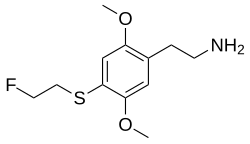
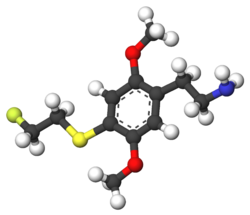
2C-T-21, or 4-(2-fluoroethylthio)-2,5-dimethoxyphenethylamine, is a synthetic psychedelic in the 2C-T family. It differs from 2C-T-2 by a fluorine atom on the ethylthio side chain. The compound has been identified in a drug-checking sample in the Netherlands and is expected to act on serotonin receptors, but its pharmacology is poorly characterised. A fatal intoxication has been reported in the clinical literature.
Chemistry and identification
2C-T-21 retains the 2,5-dimethoxyphenethylamine structure of the 2C series. Its 4-position substituent is a fluoroethylthio group, which distinguishes it from the methylthio, ethylthio and propylthio groups found in 2C-T, 2C-T-2 and 2C-T-7.
The European Monitoring Centre for Drugs and Drug Addiction formally notified the substance in May 2021 after a sample sold as 2C-T-21 was identified by a Dutch drug-checking service in Amsterdam. The sample was confirmed using GC-MS and LC-DAD (EU Early Warning System notification, 2021).
Pharmacology
There is little direct pharmacological research on 2C-T-21. The EU notification classifies it as a hallucinogen and expects activity at serotonin receptors based on its structure and similarity to 2C-T-2. In a 2018 study of 2C-series compounds, 2C-T-21 was included in an in-vitro monoamine oxidase screen, but its MAO inhibition values could not be determined (Wagmann and colleagues, 2019).
A separate study of 4-thio-substituted phenethylamines found potent 5-HT2A and 5-HT2C receptor interactions across the 2C-T series. These results provide a class-level context, but do not replace a complete receptor profile for 2C-T-21 itself (Luethi and colleagues, 2018).
Subjective effects
The PsychonautWiki profile of 2C-T-21 offers only limited anecdotal information. Its classification and relationship to other 2C-T compounds suggest psychedelic activity, but reliable reports are too few to establish typical visual, cognitive or emotional effects.
Clinical toxicity
A fatal case involving 2C-T-21 was presented at the 2005 North American Congress of Clinical Toxicology. A 22-year-old man developed rapid visual disturbance, tachycardia, hyperthermia, hallucinations and seizures, followed by cerebral oedema and haemorrhage. The case report described death after severe neurological deterioration (Arnold and colleagues, 2005).
The older 2C-family review also lists a fatal 2C-T-21 case involving hyperthermia, seizures and coma. These reports are important but do not establish a reliable concentration threshold or a complete toxicological profile.
Toxicity and research limitations
Human data on 2C-T-21 are extremely limited. The fatal report demonstrates that severe poisoning has occurred, while the EU notification records a later analytically confirmed drug-checking sample. There are no controlled human studies defining its pharmacokinetics, dependence potential or long-term effects.
Related compounds
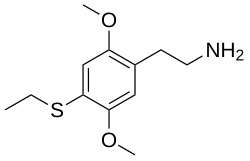
2C-T-21 is related to 2C-T-2, 2C-T-7 and other sulfur-substituted 2C phenethylamines. Its fluoroethylthio substituent makes it structurally distinct from the other members of the group.
Reviews
There are no reviews yet.